skip to content
initiative · digital inclusion

from the first click to autonomy.

Basic digital education for people at their first contact with a computer: learning tracks by age group, built from the Bytes de Mudanças field research and transferred as social technology to social assistance organisations in Campinas.

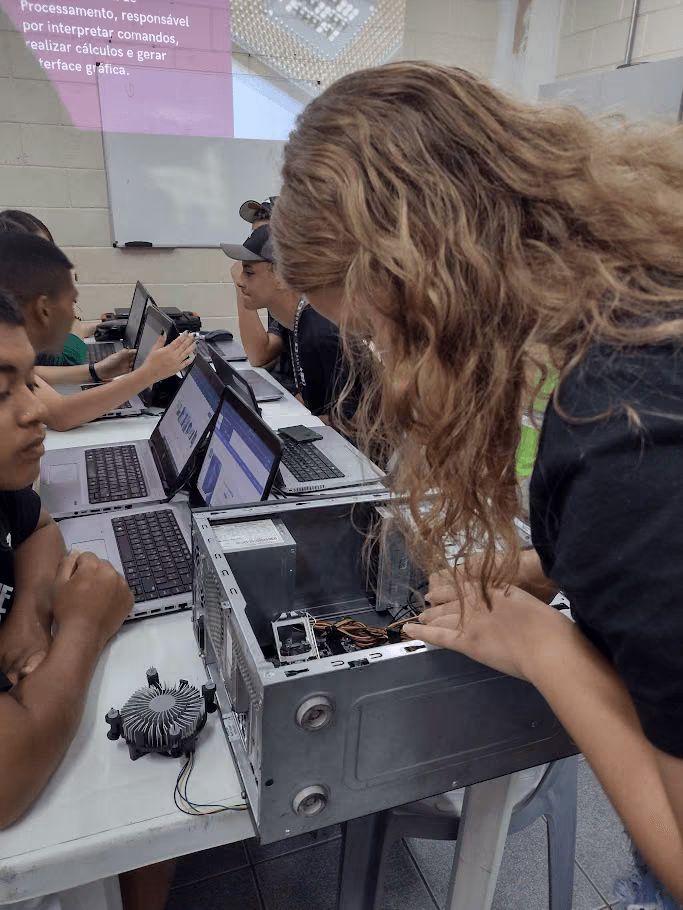
A basic digital education class of Inclusão Tech in Campinas, with participants at laptops

Campinas · São Paulo State

5tracks by age group
6venues in campinas
+5organisations using the method
303people heard in the research

Inclusão Tech is Casa Hacker’s complete pedagogical route for basic digital education, designed for people at their first contact with a computer. The conviction behind the programme: digital inclusion is a tool to strengthen social and economic inclusion and access to rights in the age of digital transformation.

The tracks were not designed at a desk — they are the direct outcome of the Bytes de Mudanças (in Portuguese) field research, carried out with Instituto Semear and Fundação FEAC, and became the open collection From the First Click to Autonomy (in Portuguese), with the training of educators documented in a first-hand account.
// how it works

the pillars of the programme

01

Research before the classroom

Everything starts by listening to the territory: the Bytes de Mudanças research (2024) mapped — with educators from the neighbourhoods themselves — the digital access, fears, skills and dreams of 303 residents of Parque Via Norte and Vila Olímpia. That listening is what designs the curriculum.

02

Tracks by age group

Five volumes of open methodology — children, teenagers, adults, people aged 50+ and topics of interest — with practical routes running from playful digital literacy to job searching, public services and safe behaviour online.

03

Social technology that transfers

More than teaching classes, Inclusão Tech trains educators and managers at social assistance organisations to run the tracks independently — the methodology has already been transferred to more than 5 organisations in Campinas.

04

Infrastructure that follows

Setting up and upgrading technology infrastructure at partner venues — from a notebook-first model to adaptations of furniture and connectivity — so that the class happens where people already are.

// frequently asked questions

before you apply

Where do the classes happen?

At six partner organisation venues in Campinas: the two Instituto Semear units (Parque Via Norte and Vila Olímpia), ADRA, CECOMPI, Casa Santana and Núcleo Calvariano.

How much does it cost to take part?

Nothing. The training is free, in person and open to the community in the territories served.

Can my organisation use the tracks?

Yes — the five tracks are published as open social technology, with the PDFs available on the collection page. For assisted transfer (training of educators and advisory support), write to falae@casahacker.org.

// from the house’s open notebook

publications about this initiative

see all →
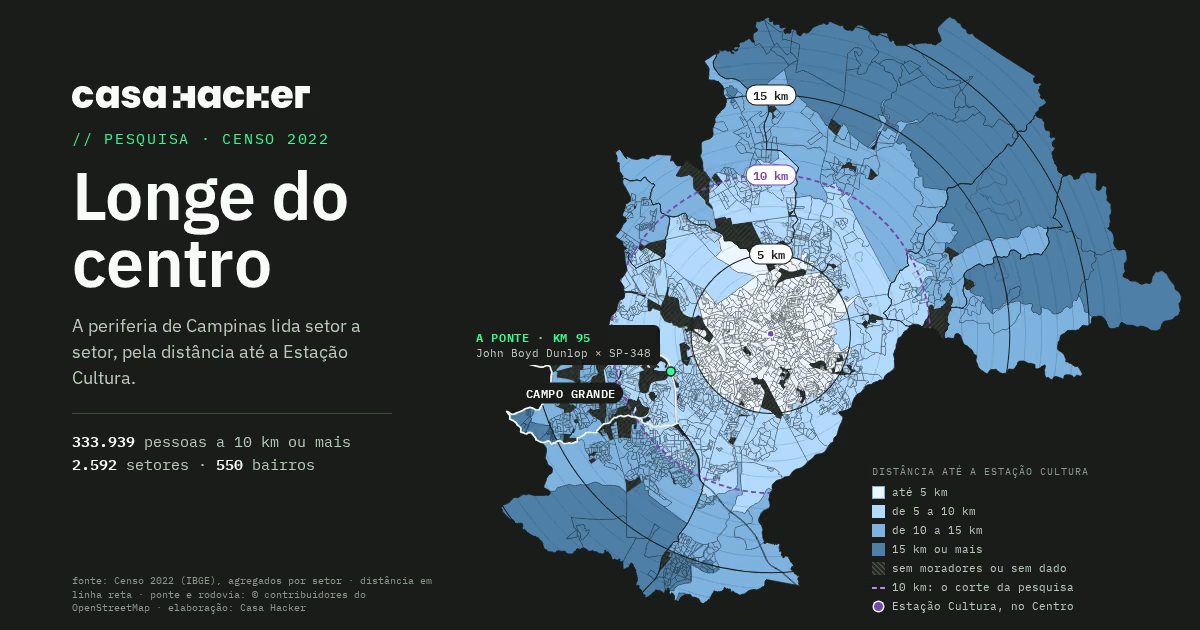
Cover of the research "Far from the center" by Casa Hacker. On the left, on a dark background, the Casa Hacker logo, the tag "// RESEARCH · 2022 CENSUS", the title "Far from the center", the phrase "The periphery of Campinas read tract by tract, by distance to Estação Cultura" and the numbers: 333,939 people 10 km or more away, 2,592 tracts and 550 neighborhoods. On the right, the map of Campinas with the 2,592 census tracts in four shades of blue by distance to Estação Cultura, from lightest in the center to darkest at the edge, with circles every kilometer and the 10 km one dashed in violet. To the west, the outline of the Campo Grande district and a green point on the bridge of Avenida John Boyd Dunlop over the Rodovia dos Bandeirantes, with the tag "The bridge · km 95".
Institutional Development

Far from the centre: what the 2022 Census shows about the periphery of Campinas

333,939 people, 29.3% of Campinas, live 10 km or more from the center. There, the median income of the head of household is R$ 2.567, compared to R$ 3.791 nearby, and there are more Black and brown people, more children, and less piped sewage. But distance doesn't explain everything: direction also matters.

The image consists of an informational card produced by the organisation Casa Hacker based on 2022 Census data about the Campo Grande district in Campinas. On the left side, against a dark background, the institution's logo stands out, along with the category label "// RESEARCH · 2022 CENSUS", the highlighted title "Campo Grande" and the summary "Demographics, income, education and connectivity in the district of the Northwest region of Campinas, read tract by tract", accompanied by statistics of 125,044 people, 256 tracts and 43 neighbourhoods. On the right side, a cartographic visualisation of the district's perimeter is displayed, divided by census tracts and represented through a palette of purple, lilac and dark grey areas with geographic hatching.
Institutional Development

Campo Grande: demographics, income, education and connectivity in the IBGE 2022 Census

Territorial diagnosis of the Campo Grande district, Northwest region of Campinas (SP), based on sample microdata and census tract aggregate data from the IBGE 2022 Demographic Census: demographics, income, education, occupation and connectivity, featuring an interactive map of the 256 tracts and a critical reading of the territory.

STEAM Education

Educator training in Inclusão Tech

As the final stage of the Redes Conectadas project, Casa Hacker trained educators from four institutions so that each one could carry digital inclusion forward in their own territory.

// accessibility

Accessibility provisions are made on individual request. Ask for what you need — Libras interpreting, audio description, physical accessibility, individualised support, priority service and others.

Ask at least 15 days in advance: with that notice we can guarantee it; with less, we will make every effort but cannot promise.

falae@casahacker.org · Accessibility Statement

Inclusão Tech in your territory

Want to take part, support this, or bring this initiative to your school, collective or city? The house opens its door.

falae@casahacker.org

// who makes this initiative possible

delivered by

  • Casa Hacker
  • Instituto Semear

support

  • Fundação FEAC

project partners

  • ADRA
  • CECOMPI
  • Casa Santana
  • Núcleo Calvariano

Donate

The link opens the BTG Pactual donation page, with the payment methods available there.

Donate in reais

From outside Brazil

For an international transfer, use the details below. Pick the currency: what changes between them is the intermediary bank.

The field names are in English because that is how they appear in your bank’s transfer form.

The same for both currencies

Creditor Agent (BICFI)BPABBRRJ
Creditor AgentBANCO BTG PACTUAL S.A.
Bank addressPraia de Botafogo, 501 — Rio de Janeiro — Brazil
IBAN / OtherBR8130306294000500002143176C1
BeneficiaryASSOCIACAO CASA HACKER
Beneficiary addressRua Doutor Renato Paes de Barros, 618 — Itaim Bibi — São Paulo — SP — 04530000 — Brasil

USD

Intermediary Agent (BICFI)CITIUS33
Intermediary AgentCITI, NEW YORK — US
BTG account with intermediary36317173

EUR

Intermediary Agent (BICFI)CHASDEFX
Intermediary AgentJP MORGAN FRANKFURT — DE
BTG account with intermediary6231431278

Remittance Information is optional: use it to identify the payment if you want to.

Check the details on your bank’s screen before confirming the transfer.

see the full page →