Innovation
A culture of active listening to the territories, and of building solutions that respond to their realities.
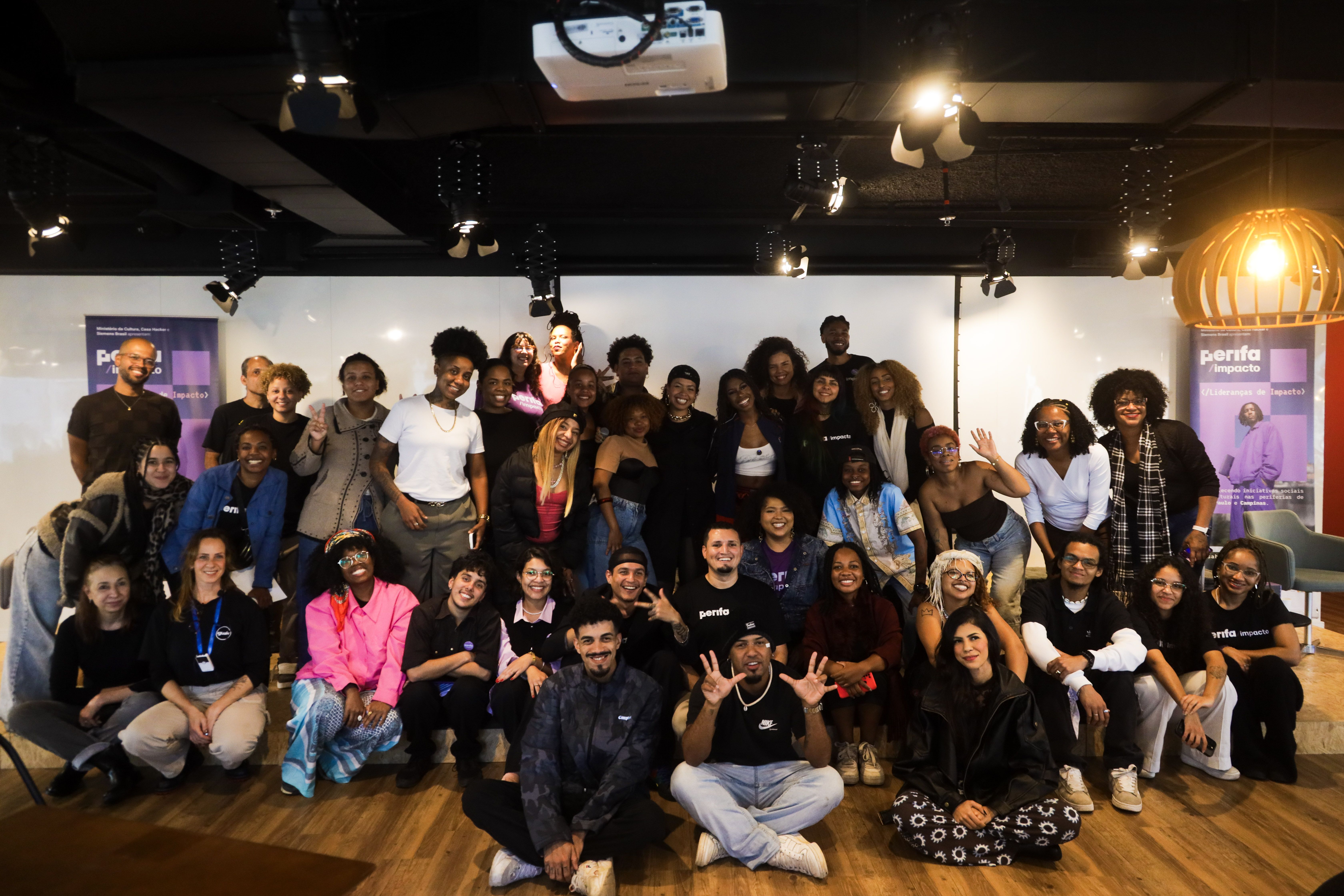
Associação Casa Hacker is a non-profit organisation, born in 2018 in Campinas (São Paulo State, Brazil) and formally constituted as an association in 2019, dedicated to the technological emancipation of people and collectives in the periphery — strengthening the capacity of these territories to transform their own realities through technology, science and social innovation.
The future is not a distant thing; it lies in the choices we make right now, in the hands of those who turn scarce resources into abundant creativity. When Casa Hacker is born, so is the certainty that the peripheries are not a place of waiting — they are a place of beginning: the beginning of ideas, of technologies, of innovation, of new ways of living and of deciding the future of one’s own story.
We start from the conviction that the turning point does not come from outside; it comes from the periphery itself, once it has access to opportunity, tools, connections and respect. We know that many people grew up without ever seeing an open door to study science, technology and innovation, to work with what they love, or to turn a neighbourhood project into public policy. Yet even when those doors fail to appear, the peripheries keep inventing their own paths: they build community networks, they start impact businesses with whatever is at hand, they teach what they have learned back to their territory. Casa Hacker commits to strengthening these paths, creating real opportunities so that what already exists at the grassroots gains structure, visibility and a future.
Our commitment is to treat technology as a right and as a language of power, not as the privilege of a few. That means building spaces where everyone can learn, experiment and create with technology in a safe, accessible and creative way. It means walking alongside schools, organisations and collectives so that education in science, technology and social innovation speaks the language of the periphery, opens doors to work, and generates solutions that are born in the territory and return to it as income, strength, care and participation.
The change we seek is not a quick project; it is a daily construction of bonds, trust and autonomy. By supporting local leaders, collectives and initiatives, we want more people from the periphery to occupy the places where decisions are made. Our commitment is to keep shifting the centre: to take the periphery out of the footnote of the conversation and place it as the lead author of the answers to the challenges of our time.
The future is not a distant thing, because it is already being written now — in every class in a hacker lab, in every young person who discovers they can code, in every resident who understands their digital rights and decides to use them to protect their territory. Casa Hacker exists so that this future moves from the possible to the everyday: a Brazil where science, technology and social innovation are in the hands of those who have always been left aside, and where the peripheries are recognised as the place where new ideas of technology, science, justice, work, culture and democracy take shape.
Anyone who wants to walk with us is welcome: let’s program other futures, starting from where everything is already happening.
We believe the peripheries are rich in innovation, technology, science and creativity — and that the barrier to inclusion is the absence of opportunity, not of talent. We have already influenced public policy on digital rights, trained people in technology and prepared young people for tech careers, with programmes in privacy, digital security and countering disinformation.
tagline · technology and social innovation for the sustainable development of the peripheries
To technologically emancipate people and collectives in the peripheries, strengthening their capacity to develop their own territories.
To build the largest and most vibrant network of hacker labs in Brazil — creating opportunities in STEAM education and social innovation for peripheries across the country.
The principles that guide every decision, from field operations to the executive level.
A culture of active listening to the territories, and of building solutions that respond to their realities.
Actions that inspire and produce concrete, transformative change.
Advocacy for open software and hardware, for universal access to knowledge.
An unwavering commitment to the institutional mission in every decision.
A plurality of voices, cultures and perspectives as the engine of innovation.
Engagement that honours our commitments to people and territories.
A community that takes part in governance, from project level to the executive.
We build opportunities in science, technology, engineering, arts and mathematics, turning community spaces into innovation labs.
our vision →We invest in grassroots impact leaders who transform their territories through social innovation, technology, science and creativity.
our vision →We develop socio-digital inclusion for all ages — from a first contact with a computer to privacy and safety online.
our vision →We train young people in civic participation and advocate on public policy for digital rights, education, youth, race and gender.
Change is complex and interconnected. Our focus is to shift the power dynamics that perpetuate inequality, exclusion and injustice — from grassroots knowledge to long-term impact.
download and read our theory of change (pdf)Knowledge
Our experience, social technologies and findings.
People
A team experienced in developing impact initiatives.
Ecosystem
Our networks, partners, companies, funders, organisations from the territories, the territories themselves, governments and more.
innovation
STEAM Education
Developing STEAM education initiatives focused on young people, turning them into social technologies, and building an ecosystem that fosters and implements those initiatives across the country in a decentralised way.
Social Innovation
Encouraging territories to propose local development solutions, focused on social and economic development, and on civic and political participation as a route to spaces of power.
Digital Inclusion
Developing socio-digital inclusion initiatives for people of all ages, turning them into social technologies, and building an ecosystem that fosters and implements them nationally in a decentralised way.
ecosystem
Funding and Resources
Mobilising resources from diversified public and private sources to fund the "Innovation" strategies, including sharing those strategies with the ecosystem.
Public Policy Advocacy
Designing and supporting initiatives and advocacy strategies on public policy for digital rights and for science and technology education, alongside cross-cutting agendas: youth, race and gender.
short term
long term
The network was born in the Metropolitan Region of Campinas and moves with the people of the territories — every point on the map is organised people turning technology into local development.
Metropolitan Region of Campinas · São Paulo State
campinas · sumaré · americana · nova odessa — the network’s base since 2018
São Paulo · São Paulo State
head office + leaders and clubs expanding across the east side
Rio de Janeiro · RJ
hackerclubes at the nave do conhecimento in penha · working with local ngos
Casa Hacker began its journey in 2018 as an informal collective; in 2019, Associação Casa Hacker — a private, non-profit association — was constituted to coordinate, fund and provide legal support for the long-term development of its initiatives. Keeping our processes transparent and open to community collaboration is part of our culture: here we publish our institutional, historical, strategic and financial records.
Associação Casa Hacker
CNPJ (Brazilian company registry) 36.038.079/0001-97
Private non-profit association · constituted in 2019
Tax-immune under article 150, VI, of the Brazilian Federal Constitution
financial year 2026
Revenue by type of instrument — without naming supporters — and expenditure by the classification used in our own financial management. Restricted funds have a use agreed with the supporter and cannot be spent freely.
provisional · through Dec/2026
restricted unrestricted
by nature of expenditure
outside the operating result: R$ 136 mil invested in equipment, facilities and reserves — assets, not expenditure
restricted unrestricted
by nature of expenditure
outside the operating result: R$ 86 mil invested in equipment, facilities and reserves — assets, not expenditure
restricted unrestricted
by nature of expenditure
outside the operating result: R$ 5 mil invested in equipment, facilities and reserves — assets, not expenditure
restricted unrestricted
by nature of expenditure
outside the operating result: R$ 4 mil invested in equipment, facilities and reserves — assets, not expenditure
restricted unrestricted
by nature of expenditure
outside the operating result: R$ 30 mil invested in equipment, facilities and reserves — assets, not expenditure
The integrated financial management that feeds these charts starts in 2022. For the 2021 financial year, see the signed financial statements just below.
The integrated financial management that feeds these charts starts in 2022. For the 2020 financial year, see the signed financial statements just below.
Series since 2020. Published as public copies: the CPF numbers (Brazilian individual taxpayer IDs) in the signature footer were removed, which invalidates the file’s digital signature — the original signed copies are available at operacoes@casahacker.org.
partial · January to May
trial balance, balance sheet and income statement in a single document, signed with the association’s e-CNPJ certificate · no explanatory notes
trial balance, balance sheet and income statement in a single document · no explanatory notes
R$ 1,6 mi (BRL) in conditional grants awarded to organisations and leaders since 2022 — published line by line, with grantee, project, amount and date, in the model of the grants databases of major foundations.
original signed copies, the founding minutes and the shareholder record are available on request: operacoes@casahacker.org
All of the house’s governance is published at docs.casahacker.org (in Portuguese).
integridade
legais e dados
compras, pagamentos e viagens
Casa Hacker holds the trademarks "Casa Hacker", "PerifaImpacto", "Minas em Tech", "Inclusão Tech" and "Hackerclubes" — so that people can tell official projects apart from independent projects that use our technologies, infrastructure, space, investment or any other form of support.
A team experienced in developing impact initiatives — most of them from the periphery themselves.
Geraldo Barros
Executive Director · co-founder
Systems analyst, developer, facilitator and educator with a track record in research, technology and social innovation. Founder of Casa Hacker, a STEAM education organisation based in Campinas (SP) and a reference point in peripheral communities; previously at the Mozilla Foundation, where he worked as a researcher for the Internet Health Report, as Wrangler of the Mozilla Festival Program for Trustworthy AI, and as creator of the Privacy Board Game, and was recognised as one of the 50 people who made the Internet a better place in 2016 in the Mozilla Foundation's global Network 50 awards.
Amanda Santos
Project Manager
A graduate in Social Sciences and in Political Science from UNICAMP, born and raised in Jd. São Miguel, in Cotia, I am a Sociology teacher and a manager of projects focused on young people, social collectives and education, in impact organisations for more than five years. I have worked on initiatives that promote technological emancipation and the inclusion of girls in STEAM areas, such as the Minas em Tech project, and I led digital security training with Data Detox for Educators, in partnership with Tactical Tech. I have worked as a manager on projects carried out in different states and peripheral territories of Brazil with a focus on community strengthening and public education, in institutions such as Casa Hacker, Fundação FEAC, Roda Educativa, Itaú Social and Instituto Gesto. My path began in cultural and educational collectives and, since then, I remain committed to developing educational, inclusive solutions with a focus on real social impact.
Karla Marques
Project Manager
Project Manager of the Hub Quebrada em Movimento and a cognitive behavioural therapist, whose work is focused on the development and strengthening of Black women from the periphery. She holds a postgraduate degree in People Management from USP/Esalq and a degree in Financial Management from Uniube, and is a specialist in neurolinguistic programming and a Master Trainer certified by SBCE. She also works as a speaker and facilitator, using self-knowledge as a central tool of personal and collective transformation.
Marcelo Oliveira
Project Manager
Marcelo Oliveira, also known as Dustin Maia, is an artist, music producer, entrepreneur and project manager at Casa Hacker. He works on strengthening community leaders and social impact initiatives in peripheral territories of Campinas. Since 2016 he has been developing cultural, educational and community projects aimed at widening opportunities and access to culture, technology and civic participation.
Nara Leme
Project Manager
A geographer trained at UNICAMP, I am a manager at Inova Quebrada, where I work directly on strengthening leaders from the peripheries. Day to day, I organise processes, systematise data, build reports, support leaders and design strategies and activities that connect training, territory and social impact. My path runs through public education as a Geography teacher, through maker and STEAM education, and through work as a social educator with women, girls and people with intellectual disabilities. Communication is one of my main working instruments, whether in writing texts, in caring for people or in turning ideas into concrete actions. Born and raised in Parque São Jorge, in Campinas, my practice is shaped by the experience of living and learning in peripheral territories, where I recognise education as a continuous and collective process, and social transformation as something that already begins within the territory itself.
Aliene Villaça
STEAM Pedagogical Coordinator
Pedagogical Coordinator for the STEAM area at Hacker. Educationalist, researcher and PhD in Education, with an established track record in digital education, innovative methodologies and digital culture in education. She works in the pedagogical coordination of programmes focused on digital inclusion, STEAM and maker culture, and has experience in producing teaching materials and training teachers. She brings more than fifteen years of work in education, with a focus on practices that promote inclusion, diversity and active participation by students. @alienevillaca
Hellio Couto
Pedagogical Coordinator
Coordinates, plans and guides the training journey with the leaders and impact advisers.
Ocian Junior
Educator · Hackerclubes
A social and technology educator since 2013, he works with different audiences on projects in learning, inclusion and social development. He is currently part of the Hackerclubes team, running activities in state schools and promoting access to technology through creative, collaborative experiences connected to the students' reality.
Celso Niger
Social and Environmental Impact Adviser
Celso Níger is a social and environmental impact adviser on the Quebrada em Movimento project; he is also a poet, cultural producer and internationally certified project manager at NaViela.
Suellen Soares
Impact Adviser
A Black woman, mother of two girls and a resident of Hortolândia (SP). An administrator and postgraduate student in the History of Afro-Brazilian Culture, social entrepreneur, business mentor, consultant on social, cultural and creative economy projects, Impact Adviser at Casa Hacker. I work directly with leaders from the outskirts, providing one-to-one advice, facilitating gatherings and following the development of initiatives in the PerifaImpacto and Inova Quebrada projects. My path is devoted to strengthening women and people from peripheral territories, turning real experiences into tools of guidance, encouragement and development, seeking to widen paths to autonomy and helping others to structure their projects with more confidence, purpose and impact.
Patrícia Polzl
STEAM Teacher
Patrícia Polzl is a visual artist, a master's student at Unicamp, and has worked as a pedagogical developer and STEAM teacher since 2022. Her practice brings together art, technology and education through classes in programming, 3D modelling, video mapping and active learning methodologies. She develops collaborative experiences with a focus on creativity, experimentation and collective learning.
Pamela Moraes
STEAM Teacher · Hackerclubes
Pamela Moraes is an IT technician trained at IFSP, a graduate in Social Communication - Midialogia from Unicamp and a master's student in Brazilian Identities and Cultures at USP. She works as a STEAM teacher on Casa Hacker's Hackerclubes project, with a focus on creative programming and electronics.
Helen Camillo
Communications Assistant
She works as a Communications Assistant at the Hub Quebrada em Movimento, responsible for producing audiovisual content and strategic visual assets for the digital platforms. Her work focuses on turning institutional objectives into high-impact posts, improving engagement and the organisation's visual narrative.
Beatriz Romanello
Communications Assistant
Communications Assistant at Casa Hacker, with a degree in Social Communication from Unicamp.
Everton Justo
Compliance Analyst
Compliance Analyst at Casa Hacker, with a degree in Financial Management and Controllership from Faculdade Mario Schenberg.
Melissa Suda
Management and Administration
Works in the management and administration of Casa Hacker, with a degree in Management of Civil Society Organisations from FIA.
Raquel Garboggini
Intern
Intern at Casa Hacker, with a technology degree in Systems Analysis and Development from Fatec Campinas.
Vitor Coelho
Communications Manager
Communications Manager at Casa Hacker, with a degree in Product Design from USP.
Yasmin Carolina
Project Assistant
Project Assistant at Casa Hacker.
Shall we build together? We are always on the lookout for people who want to transform territories with technology.
SEE_OPEN_ROLES →Since 2023 we have offset the impact of our cloud operations through reforestation, via Tree-Nation. For organisations that make intensive use of cloud technology, adopting sustainable practices is more than a choice: it is a duty.
Amazônia · Rio Terra Brasil · Mata Atlântica · Copaíba · Sistema Cantareira · Semeando Água · Usambara · Tanzânia · Eden Reforestation · Madagascar — data as of 27/08/2026 · source: Tree-Nation profile
see our forest on tree-nation ↗From an idea in Campinas to a network scaling to São Paulo and Rio. The milestones that brought us here.
The idea is born at Casa de Cultura Itajaí, from Geraldo Barros and Isabel Barbosa. A first R$ 25,000 (BRL) raised from Fundação FEAC, a partnership with the Mozilla Foundation, and the building of our first lab.
Formal constitution as a non-profit association. Admission to Pense Grande Incubação (Telefônica Vivo), programmes in the schools of Campo Grande, and the festival that launched Hackstation, our first fablab.
First leadership development programme. With the pandemic, activities move online — digital security, creative economy, podcasts, original publications, guides and streaming — and the Quebrada em Movimento hub is born, in partnership with FEAC.
PerifaImpacto consolidates; sponsorship from Instituto Robert Bosch takes Hackerclubes to 3 territories; national training in privacy and security; the Brazilian edition of "The Glassroom Misinformation".
Launch of Minas em Tech (PPG Brasil) in Sumaré; 2nd edition of PerifaImpacto with 5 collectives; in-house Academy with Gerando Falcões; Mulheres em Tech with the British Council; advisory support to the São Marcos Community Hub (Campinas); the Glassroom Community Edition and What The Future Wants exhibitions; World Creativity Day.
Joining the Coalizão pelo Impacto; PerifaImpacto Negócios de Impacto with ICE; a STEAM lab in Jardim Campo Belo (Instituto ProDica + Amazon); Casa Hacker convenes the Coalizão pela Genialidade Feminina, backed by the international Rise Up programme, advocating on Bill 840/2021; Glassroom and What The Future Wants reach Rio de Janeiro and São Paulo.
Launch of the new Theory of Change; the Inclusão Tech programme; field research on Digital Skills (Instituto Semear + FEAC).
Hackerclubes scales to São Paulo and Rio de Janeiro, and PerifaImpacto to São Paulo.
Our web series tells the stories of entrepreneurs who came through Casa Hacker’s social innovation programmes. More videos on our YouTube channel. (In Portuguese.)
the youtube player (privacy mode) only loads when you press play.
Not every good idea has to last forever — but everything we learned from them deserves to stand. Data, stories and knowledge remain open for consultation, research and inspiration.
The mapping of social technologies in Campinas, with Fundação FEAC: 108 initiatives from 90 organisations, in a browsable directory with search and filters.
explore the archive →The mobilisation of young people from the five regions of Campinas in civic education, with support from FEAC. The page remains online as a living record of the initiative.
find out more →Got a question? A partnership proposal? Want to help us with something, or need our help? Want to run an activity in our space, or tell us about your experience at one of our gatherings? Write to us.
General: falae@casahacker.org
Operations: operacoes@casahacker.org
R. Dr. Renato Paes de Barros, 618, Cj 01
Itaim Bibi · São Paulo · SP · 04530-000
get directions →R. Luverci Pereira de Souza, 545
Cidade Universitária · Campinas · SP · 13083-740
get directions →Casa Maria de Nazaré – Unidade Casa dos Anjos
R. Ondina Moreno de Lima, 546 – Mezanino – Jardim Liliza, Campinas – SP, 13058-272
E. E. Maria de Lourdes Martins
Rua Osvaldo Vacari, 777 – Jardim Maria Antonia (Nova Veneza), Sumaré – SP, 13178-374
E.E. Wadih Jorge Maluf
Rua Santa Clara, 238 – Jardim Santa Clara, Sumaré – SP, 13179-215
ADRA Núcleo Prof. Cassia Lasca
Av. Engenheiro Augusto Figueiredo, 2341 – Jardim Bom Sucesso, Campinas – SP, 13045-248
Centro Comunitário da Criança do Parque Itajaí I e Região
R. Pe. Jósimo Moraes Tavares, 164 – Conj. Hab. Parque Itajaí, Campinas – SP, 13058-011
Casa Santana Jardim Florence
R. Lasar Segal, 230 – Jardim Florence, Campinas – SP, 13059-016
Casa Santana Jardim Rossin
R. Gertrudes Môro Rossin, 524 – Jardim Rossin, Campinas – SP, 13059-235
Casa Santana Campina Grande
R. Araken Patusca, 138 – Campina Grande, Campinas – SP, 13058-653
Núcleo Calvariano
R. Nossa Sra. do Calvário, 157 – Jardim São Pedro de Viracopos, Campinas – SP, 13056-219
Common questions about who we are, how to support us and how to bring Casa Hacker to your territory. Want to see the house in motion? Follow our YouTube channel.
A non-profit association created by people from the periphery. Born in 2018 in Campinas and constituted as an association in 2019, it works for the technological emancipation of people and collectives in the peripheries — making technology, science and social innovation a place for everyone. Casa Hacker and its founder, Geraldo Barros, were finalists in Pense Grande 2019 (Fundação Telefônica Vivo), a competition with more than 1,500 young people and impact businesses from across Brazil.
We were born in 2018 in the periphery of Campinas (São Paulo State) to give an emerging response to fake news and online disinformation through digital and media education. At Casa de Cultura Itajaí, founders Geraldo and Isabel created and ran workshops and digital inclusion programmes for more than 12 months. As the activities succeeded, more than 10 volunteers joined, local foundations and companies donated resources, and the project became an organisation with several social impact and technology programmes.
A civil society organisation: a private, non-profit association dedicated to generating social impact. We operate as an open and transparent organisation with professional management — we generate revenue, but our focus is impact, and we have a statutory commitment to reinvest every operating surplus back into Casa Hacker: no profit or share of assets is distributed.
Through diversified revenue: one-off and recurring donations from Brazilian and foreign individuals and companies; direct project and institutional sponsorship; services such as social impact consultancy, corporate volunteering and data protection; tax incentives; and income from net assets and funds.
Donate through our donation button at BTG Pactual; become a partner or funder by writing to falae@casahacker.org; or add to our carbon offset forest at Tree-Nation. Every contribution becomes a real opportunity in the territories.
We recruit volunteers with a wide range of skills and backgrounds through the Atados platform. More than 300 people have volunteered at Casa Hacker since 2018.
Hackerclubes turn schools and community spaces into innovation labs. To open a front in your city or school, talk to us at operacoes@casahacker.org or falae@casahacker.org — the house opens its door.
We are a physical and online lab. We operate out of Campinas and São Paulo; Hackerclubes run in Campinas, Sumaré, Nova Odessa, Americana, Rio de Janeiro and São Paulo. In person, we build infrastructure in partnership with venues, organisations, collectives, foundations and schools; online, we develop courses, podcasts, live programmes, teaching materials, research and other formats.
We are not authorised to share the contact details of guests and facilitators. Send your message with the person’s name to our e-mail and we will forward the content to them.
Send your request by e-mail with: the name and purpose of the presentation; the names of the potential facilitators; previous experience; and any other relevant information. If the project aligns with our mission, our production team will get in touch.
We issue certificates of attendance for activities held in the last 30 days, digitally by e-mail — just ask through our contact channel. Participants in regular programmes do not need to request one: they receive a certificate covering the full programme and its hours.
We do not provide technical support to individuals or companies, nor do we respond to technical emergencies by any unethical or illegal method. Victims of cybercrime should contact their local police authorities to report the incident, file a report and receive guidance.
Send your proposal by e-mail — the executive team reviews it and replies if there is alignment. We prioritise: financial support for project delivery; cause-related marketing; proposals from local and peripheral businesses or people in the regions where we work; project development with social impact organisations; institutional support for petitions aligned with our mission; and the sharing of clear, fair and aligned opportunities.
Of course — send your request by e-mail to falae@casahacker.org.
Our press office supports journalists and outlets interested in stories on science and technology education, social innovation and the transformation of peripheral territories — connecting journalists with our specialists for interviews, specialist stories and statements.
Vira Comunicação — Luiz Felipe Leite
luizfelipe.leite@viracomunicacao.com.br
brand kit: design system — guidelines and logos
This Code of Ethical Conduct sets out the values, guidelines and responsibilities that guide the behaviour of everyone who is part of Casa Hacker — staff, volunteers, partners, board members and everyone else involved. We believe there is only one way to fulfil our mission: do everything the right way, always.
Who it applies to: everyone who is part of our network — staff, leaders, beneficiaries, volunteers, service providers, suppliers, representatives, members of our own and third-party units, and members of the board, regardless of role or seniority.
A movement built by and for people from the periphery: a welcoming, safe and productive environment for everyone — no exceptions.
Respect for the dignity of every person; open technology; integrity (zero tolerance for harassment and discrimination); direct and kind communication; privacy — we do not collect what we do not need.
At events, workshops, programmes and digital channels: respect among all people, no discriminatory remarks, and consent before photographing or recording.
Violations are taken seriously — from a warning to permanent exclusion, proportionate to the severity. Reports, including anonymous ones, through the whistleblowing channel; questions about the Code are answered within 72 business hours.