
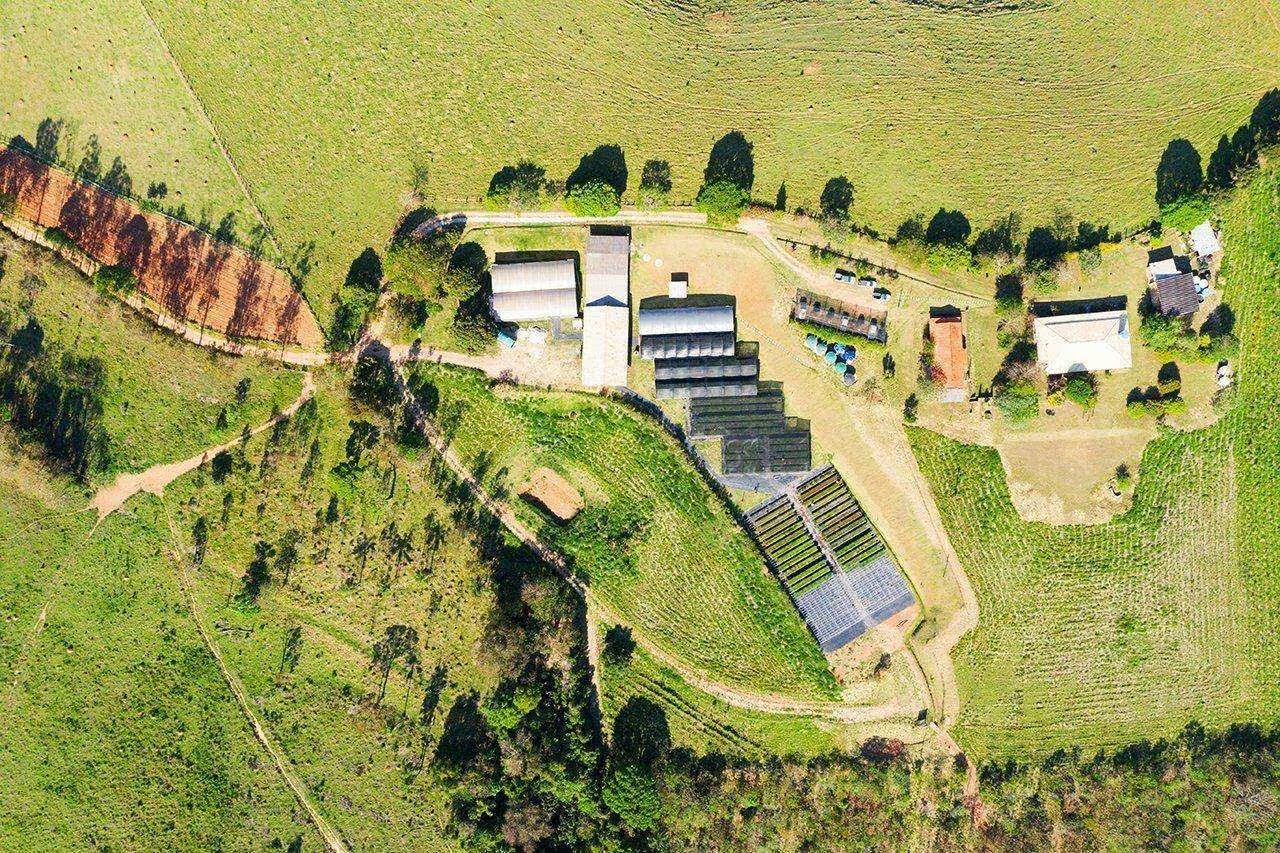
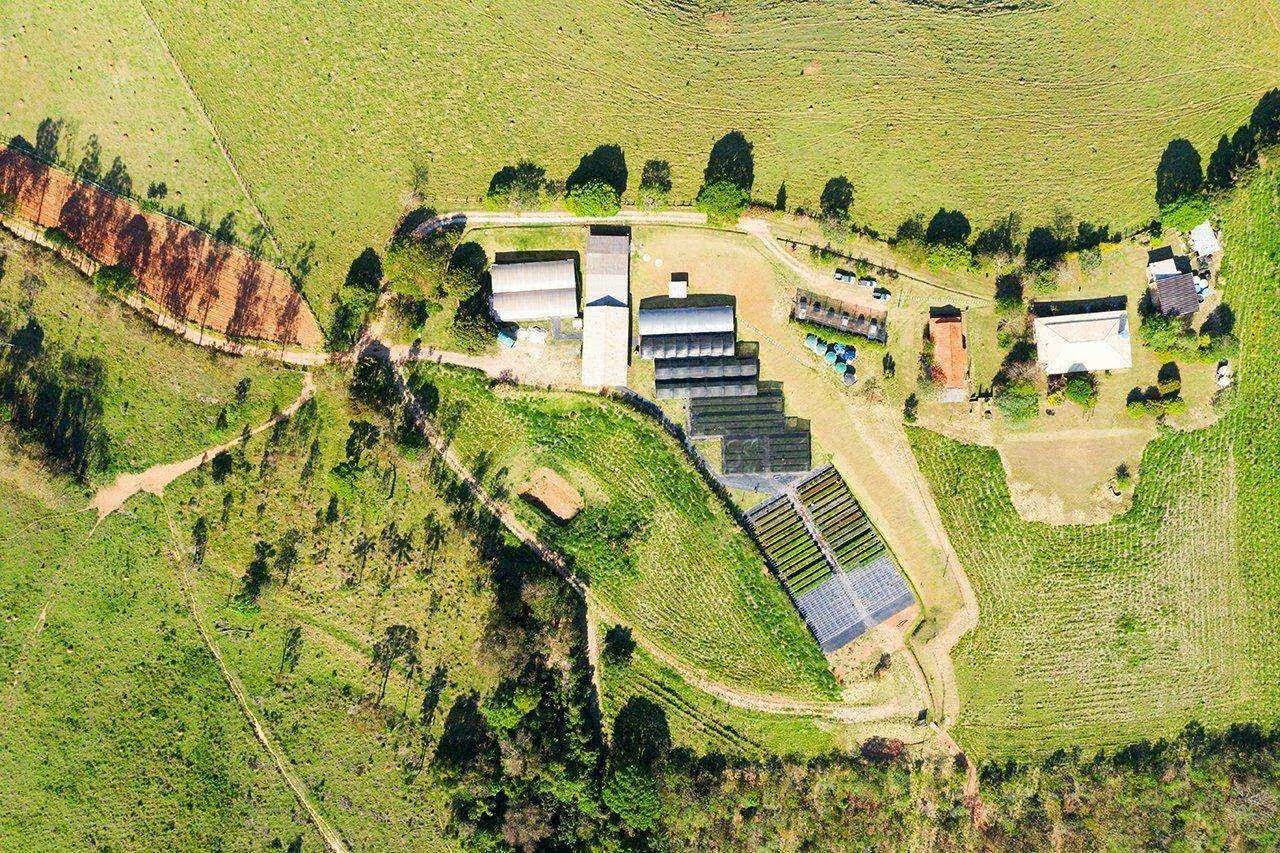
Aerial view of Copaíba’s headquarters in Socorro-SP, one of the reforestation projects supported by Casa Hacker through Tree-Nation. Recognised by the UN among the 10 most relevant initiatives in the world for environmental protection, Copaíba has already restored more than 670 hectares of Atlantic Forest, contributing to the conservation of the Peixe and Camanducaia river basins and supporting the Cantareira System.
Since 2023, Casa Hacker has taken on a commitment to the environment: offsetting the environmental impacts of its cloud operation by supporting reforestation projects, in order to bring social innovation and technology together with the environmental responsibility agenda.
By December 2025, Casa Hacker had already planted 117 trees, contributing to the capture of 19 tonnes of CO₂ and helping to reforest 0.1 hectare in reforestation areas in Brazil and Africa. This work goes beyond neutralising the carbon footprint of running our platforms in the cloud; it inspires a new culture of environmental awareness grounded also in the daily use of cloud technologies.
Global digitalisation has a growing ecological cost. The infrastructure that sustains cloud computing — networks of servers and data centres — consumes significant amounts of energy. According to the International Energy Agency, data centres consumed around 415 TWh of electricity in 2024, the equivalent of 1.5% of all electrical energy used in the world. That consumption is forecast to triple by 2028. Large technology companies illustrate the scale of the problem. Google, for example, consumed 32.1 million MWh in 2024, of which 95.8% was used by its data centres alone — more than double its 2020 consumption. Carbon emissions are alarming too. In 2024, data centres emitted 105 million tonnes of CO₂. It is estimated that by 2030 the sector could reach 2.5 billion tonnes emitted per year, especially with the increased use of artificial intelligence. AI data centres alone may consume up to 612 TWh, the equivalent of Canada’s total annual energy consumption.
Aware of the environmental impact of the cloud computing technologies we use daily, Casa Hacker adopted the Tree-Nation platform, which automatically calculates the emissions of the platforms based on daily use and offsets those emissions through tree planting.
Among the results achieved:
- 250 kg of CO₂ were neutralised from the page views of the casahacker.org website alone.
- Five trees were planted exclusively to offset the site’s traffic.
- The system calculates that for every 3,264 page views, a new tree is planted.
- So far, more than 96 thousand page views have been offset with reforestation.
This neutralisation model is automated, continuous and fully traceable.
Casa Hacker’s work takes place in partnership with reforestation projects in the following regions:
- Amazon (Rio Terra Brasil Project)
- Atlantic Forest (Copaíba Project)
- Cantareira System (Semeando Água Project)
- Usambara, in Tanzania (biodiversity conservation project)
These projects are vital for protecting river basins, regulating the local climate and preserving biodiversity. The environmental impact of each tree is recorded in real time on the Tree-Nation platform, allowing Casa Hacker and anyone else to follow the species planted, the location and the amount of CO₂ captured.
The decision to offset emissions is not merely symbolic. Studies show that migrating to the cloud can reduce carbon emissions by up to 84%, and that figure can reach 98% if systems are optimised for that environment. Complete neutralisation, however, requires complementary investment in reforestation and carbon credits. For organisations that, like Casa Hacker, make intensive use of cloud technologies, adopting sustainable practices is more than a choice: it is a duty.
About Casa Hacker Casa Hacker is a non-profit organisation, founded and led by people from the peripheries and born in the periphery of Campinas (SP). Working in Campinas, São Paulo and Rio de Janeiro, its mission is to make technology and social innovation a place for everyone through digital education and STEAM education (Science, Technology, Engineering, Arts and Mathematics). It believes in education as a tool of transformation for building a fairer and more sustainable future. In recent years, more than 120 young people have been trained in STEAM; more than 400 people — from children and adolescents to older people — have been digitally included through basic digital education programmes in more than 10 peripheral territories. The organisation has also trained more than 80 educators to protect the privacy and safety of children and adolescents online and has passed on more than R$ 500 mil directly to organisations, impact leaders and collectives for the development of innovative social impact initiatives in the peripheries.
Press relations: Vira Comunicação Luiz Felipe Leite E-mail: luizfelipe.leite@viracomunicacao.com.br
References
-
INTERNATIONAL ENERGY AGENCY (IEA). Energy and AI: data centre electricity consumption. Paris: IEA, 2024.
-
GOOGLE. Environmental Report 2024. Mountain View: Google, 2024.
-
TREE-NATION. Casa Hacker: impact and emissions offsetting profile. Available at: https://tree-nation.com/pt/perfil/impacto/casa-hacker.