
![Cover of a Casa Hacker presentation titled "[communication] Institutional strategy and positioning", with the subtitle "Connecting projects, people, methodologies, and impact". To the right, there is a photograph of two young women in an urban environment, one of them holding a green cell phone.](/enviadas/3fb5e2402807-capa-comunicacao-estrategia-e-posicionamento-ins.avif)
In August, Casa Hacker participated in the Third Sector Communication Forum, held by the FEAC Foundation. The gathering brought together civil society organizations to share experiences, discuss challenges, and collectively think about paths for communication in the third sector.
We were one of the organizations invited to present our Communication structure and open the process for discussion with the group.
For us, participation took place at an especially important moment: Casa Hacker’s Communication is being structured at the same time the organization itself is undergoing a transformation in how it operates. It was this process that we brought to the conversation.
The question that guided our presentation was simple to formulate, but difficult to answer:
How to structure an OSC’s Communication so that it stops merely communicating its projects and starts also communicating its positioning, its methodologies, and the ecosystem it is building?
An organization in transformation
Casa Hacker was born in 2018 in Campinas, and was constituted as an association in 2019, with activities focused on STEAM education, social innovation, and digital inclusion. Over the years, this work has developed through different projects, partnerships, and initiatives in the territories. Today, there are 8 projects, organized into three fronts:
-
Social Innovation
-
STEAM Education
-
Public Policies
Three fronts that, together, form a single institutional strategy.
Now, the organization is building a new operating model: an ecosystem guided by the needs of peripheral territories, connecting different actors through a common purpose and sharing knowledge, resources, and responsibilities.
This change also transforms the question we ask about Communication. While it was previously possible to think mainly about how to communicate each project, partnership, or activity, the new moment demands a broader reading. There are different projects, people, methodologies, and experiences happening simultaneously, and the issue has become how to make all of this also tell a story about Casa Hacker itself. It was from this premise that we structured our presentation for the Forum.
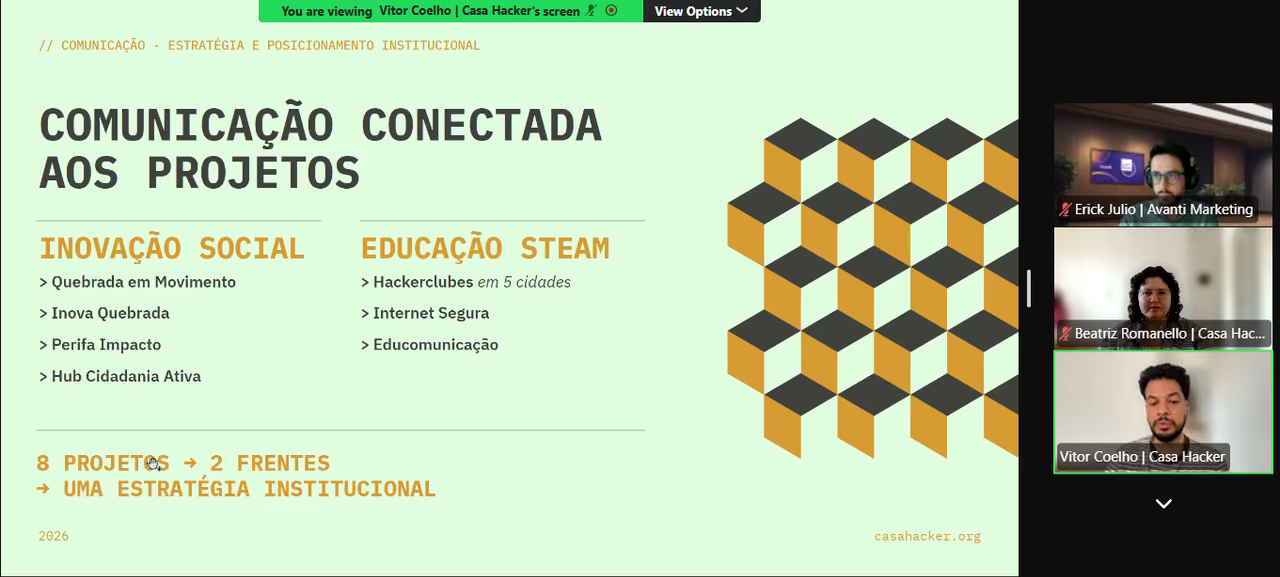 Slide during Casa Hacker’s presentation at the Third Sector Communication Forum.
Communication begins before the content
One of the things we are learning in this process is that Communication does not begin when it’s time to produce a post. It begins by keeping track of what is happening.
Today, the area consists of three people with complementary roles:
-
Vitor Coelho, responsible for management and strategy
-
Beatriz Romanello, responsible for communication and content
-
Helen Camilo, responsible for the communication of the Quebrada em Movimento project
This design translates into four lines of work:
- Strategy: communication plan, positioning, and editorial planning
- Content: social media, Publications, photography, video, and project narratives
- Relationship: project monitoring, press office, partners, and sponsors
- Institutional: printed materials, visual identity, partner approvals, and communication budget management
1The team holds monitoring meetings with the projects and, from them, organizes monthly briefings to understand the progress of initiatives, identify agendas, coverage, stories, and communication opportunities. This process feeds the four fronts at the same time, from the area’s strategic planning to the press office and institutional materials.
This closeness is important because the projects are the ones producing the experience, knowledge, and transformations we want to communicate. It is up to Communication to be close enough to understand this context and, from it, build narratives that make sense to different audiences. It is a two-way street: Communication needs to listen to what happens in the projects, but also bring its own perspective on what is happening.
From record to learning
One of the examples of this movement is in Casa Hacker’s Publications.
For a long time, an important part of institutional communication was concentrated on recording activities: what happened, where it happened, who participated, and what the immediate results were. This record remains necessary, but we began to realize that there is another layer of information that also needs to circulate: what we learned from what happened.
Questions like these began to guide this perspective:
-
What knowledge was produced?
-
What does an experience in a territory reveal about a larger issue?
-
What methodology was tested, what worked, what needed to be adapted?
-
What can be shared with other people and organizations?
This is why we are trying to transform Publications into a space for deepening, moving away from a logic of merely recording what happened to also telling what we learned. This movement changes the function of content: it ceases to be just a way to give visibility to activities and also becomes a way to organize and share the knowledge produced by the organization itself.
The question we brought to the Forum
It was in this context that we arrived at a provocation that ended up becoming the center of our presentation:
We are succeeding in communicating what happens. But are we succeeding in communicating what Casa Hacker is becoming?
The question does not stem from the idea that we have found an answer. On the contrary, it represents a challenge that is still under construction. Casa Hacker has many things to communicate: projects, territories, people, partners, results, methodologies, and stories. But communicating the existence of these initiatives does not necessarily mean communicating the identity that connects all of them. It was this space between communicating activities and building an institutional narrative that we brought to the conversation.
What the exchange brought us
The gathering took place online and divided participants into smaller groups to comment on the presented cases. We were one of the organizations that presented its case to the group.
Professionals from Avanti Marketing accompanied our group as guest experts and brought an outside reading of the moment we are living: for them, investing in structuring a Communication Plan, rather than rushing straight into content production, is exactly the path an organization at this stage should follow.
The meeting also held a surprise. Isabel Barbosa, one of the founders of Casa Hacker who is no longer part of the organization, was in the same room. Reencountering the work she helped start, now on another scale and with a Communication structure that did not exist at the time, was a reminder that the organization she helped found has grown in the right direction.
The conversation brought contributions and new provocations to think about the work we are developing, among them discussions on how to expand the spaces and formats used by Communication, how to turn project experiences into institutional narratives, and how to make communication keep pace with the changes happening inside the organization.
One of the main learnings we take from the gathering is that this Communication perspective needs to be built without detaching from the projects. On the contrary: the closer it is to the teams and experiences in the territories, the greater the possibility of understanding what is truly happening. But this proximity does not mean merely reproducing what the projects say. There is proper communication work to be done: contextualizing, identifying connections, recognizing learnings, and finding ways to make different audiences understand that experience.
Building while the organization also transforms
The Forum also helped us realize that the Communication challenge cannot be separated from Casa Hacker’s institutional moment.
We are developing a Communication Plan, scheduled for completion in November, which starts from:
-
Diagnosis
-
Audiences
-
Positioning
-
Strategies
-
Channels and narratives
-
Indicators
But this plan is not being built on a static organization: it accompanies an organization that is reviewing its way of operating, strengthening methodologies, connecting different initiatives, and building an ecosystem.
Therefore, structuring Communication also means creating processes capable of keeping up with this transformation. It is not just about deciding what to publish or which channel to use, but about understanding what needs to be communicated, to whom, why, and from what perspective.
What remains after the Forum
Participating in an exchange space like this was important precisely because we are still in the middle of the process. We did not bring a ready-made formula to the Forum. We brought a real question, built from the work we are doing, and we returned with new questions to continue this work.
Perhaps this is one of the main learnings: in an organization that is changing, Communication must also be in motion. Communicating what we do remains fundamental, but there is another task under construction: helping to make visible the connections between projects, the knowledge produced, the methodologies developed, and the purpose that guides Casa Hacker.
In the end, the question we brought to the Forum remains open:
We are succeeding in communicating what happens. But are we succeeding in communicating what Casa Hacker is becoming?
It is from this question that we continue building.