Talking about shared governance is talking about how different people and organisations manage to build something together, even when they have distinct histories, structures, priorities and ways of working. In theory, the idea seems simple: bring those involved together, share responsibilities and make decisions collectively. In practice, however, there is ongoing work to ensure that this participation actually happens and is not limited to attendance at meetings or the signing of a document.
In the article “Arranjos multi-institucionais de território: governança compartilhada”, published in September 2026, Geraldo Barros, executive director and co-founder of Casa Hacker, presents ten fronts that need to be considered before formalising a project with different organisations. The text covers everything from internal policies, legal roles and responsibilities to budgeting, decision-making processes, communication and knowledge preservation.
Building on this reflection, I want to look at another dimension: what happens after agreements are established? How does governance materialise in meetings, tasks, records, disagreements and decisions that need to be made throughout implementation?
It is from the experience in the Hubs de Cidadania Ativa – Integração project that I have been building some answers.
Governance began before it was called by that name
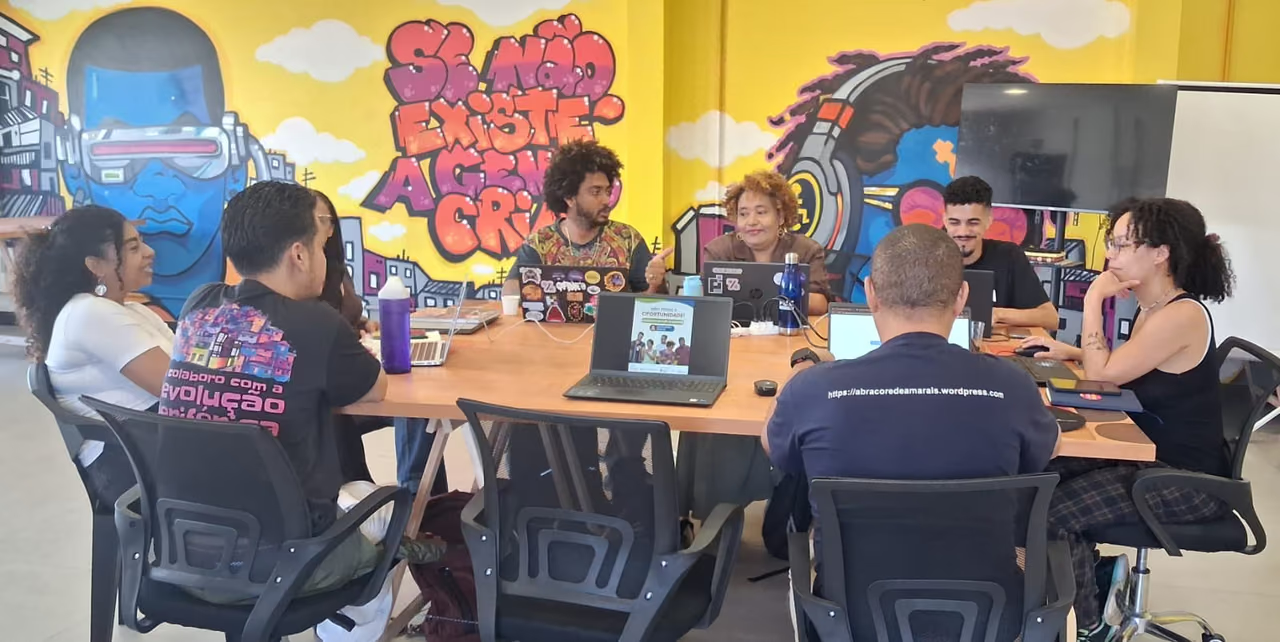
The Integração project did not simply arise from a decision to bring together three Hubs under the same management structure. For this proposal to be possible, there was a prior process of rapprochement between the teams, which began in 2024, when we started holding bimonthly meetings to share challenges, opportunities, methodologies and needs identified in the areas.
These meetings created the conditions for the teams to get to know each other’s work better, identify possibilities for collaboration and realise that many issues faced in one area also appeared in the others. Gradually, we built a relationship that went beyond the ad-hoc exchange of information.
In the current cycle, this practice has gained a more defined structure, which we call the Shared Governance Committee. Held monthly, when there are pre-established agendas, the Committee brings together representatives from organisations, Hub managers, coordination, communication teams, impact advisory, directors and the funder.
It is in this space that we discuss broader issues, such as medium and long-term strategies, major recruitments for the integrated project, results achieved, priorities, budget and the definition of roles and responsibilities.
But there is an important distinction: the Committee was not created to resolve all the operational issues of the project. When a discussion requires activity planning or alignment between specific teams, we direct the matter to Technical Cooperation meetings. Thus, for example, impact advisors can meet to organise training journeys, while local communication teams can align publication calendars and collaboration strategies.
This separation helps to preserve the purpose of each space. Not every decision needs to involve everyone, but every decision needs to take place in the appropriate instance, with the responsible people and with the steps duly recorded.
More than just creating a new meeting, the Committee has formalised an integration practice that was already being built. This difference is important because it demonstrates that shared governance does not necessarily begin with a project or a document. It also stems from relationships, trust and the teams’ willingness to build things together.
Sharing decisions also means defining responsibilities
One of the difficulties of working horizontally is finding the balance between collective participation and individual responsibility. There is a mistaken interpretation that, in shared management, everyone needs to take part in every decision or execute every task. This does not work.
In the Integração project, we use the logic of the RACI Matrix to organise responsibilities. In practice, we record the action steps in tables that identify the action, who executes it, who reviews or approves it, and what the deadline is. This adapted application of the matrix makes agreements objective and available to be consulted by anyone involved.
When an activity depends on more than one organisation, we try to divide the work according to the skills and possibilities of each team. The production of a presentation, for example, may involve one person responsible for layout, another for drafting the texts and another for selecting images and proofreading. Approval can be the responsibility of a specific team, which deliberates on the final version.
The important thing is that the pathway is agreed upon. It is not necessary for everyone to do everything, but it is necessary for each person to understand their contribution and know what is expected of them.
This clarity also helps to establish limits of autonomy. The proposing organisations and technical teams are responsible for the institutional management of the Hubs, including contracts, accountability and physical infrastructure. This does not mean they should command the political agenda of the collectives that use these spaces. Similarly, mentoring can guide, provoke reflections and support the planning of an initiative, but it should not make decisions for the collective or take over the operation of its project.
Recognising these limits is a form of care. The technical team does not replace specialised health, assistance or legal guidance services, for example. When a situation exceeds the Hub’s capacity to act, it is necessary to recognise this and seek the appropriate referral.
Shared governance is also knowing where each person’s and organisation’s responsibility ends. Sharing does not mean concentrating everything in a collective instance, let alone transferring responsibilities indiscriminately.
Meetings must produce memory and momentum
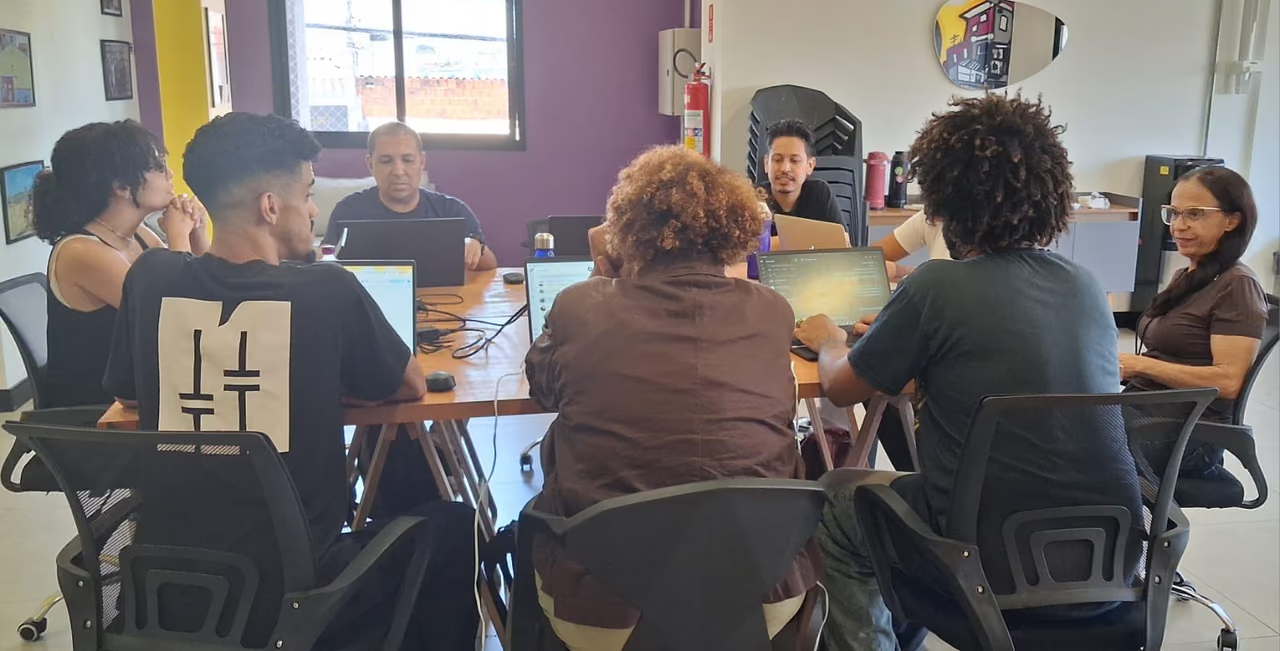
A meeting can generate good ideas, important discussions and relevant decisions. But if this information is not recorded and shared, part of the work can be lost as soon as people leave the virtual or physical room.
For this reason, we adopt a standardised minutes template. During meetings, the record is made manually, with the support of note-takers and transcription tools, used with the participants’ consent. These resources help to preserve important information and allow the people responsible for conducting and recording the meeting to pay closer attention to discussions when the situation requires it.
Afterwards, the records are cross-checked and a final version of the minutes is produced with the aid of artificial intelligence. The document may receive corrections and additions from participants, either directly in the original file through comments, or via email communication.
The minutes are made available in a shared Google Drive directory, accessible to the organisations’ teams. Casa Hacker, as the proposing organisation, assumes responsibility for the maintenance, updating, accessibility and backing up of this directory. In addition, the minutes are sent in PDF format by email, broadening the possibilities of access and reducing dependence on a single storage location.
This organisation may seem simple, but it produces an important effect on the routine. Anyone involved in the project can consult the document to understand what was discussed, what decisions were made, who was responsible for a given action and what deadline was established.
Instead of calling a new meeting, making a call or searching for dispersed information in messaging groups, it is possible to access the record and resume the subject with more context. If someone does not remember an assumed responsibility, they only need to consult the minutes. If a person did not take part in the meeting, they can catch up on what happened and understand the next steps.
I like to think of this as agile methodology in practice. Agility lies not only in carrying out tasks more quickly, but in reducing the obstacles that prevent people from acting. Organised, accessible and reliable information prevents rework, reduces friction and helps the project not to stall due to a lack of communication.
In this sense, the minutes cease to be an administrative formality and become a tool for transparency, autonomy and continuity.
Coordinating the whole without doing it for others
Another challenge arises when we need to monitor the execution of action steps. In the Integração project, the organisations involved have different structures and use their own tools to organise their activities. While Casa Hacker uses Cockpit, other teams work with Jira, Trello, Notion or internal systems.
There is not necessarily a single tool that solves all management needs. The challenge is to be able to monitor the project as a whole without disregarding the autonomy and processes of each organisation.
In this context, project coordination plays an important role. Its responsibility is not to manage each Hub locally, but to monitor the ecosystem, observe the global goals, the general schedule and the integration between the different fronts of work.
To this end, we use Cockpit as a macro-monitoring tool, in addition to emails, WhatsApp messages and events and tasks recorded in Google Calendar to reinforce deadlines and alignments when necessary.
It is work that requires attention and transparency, but it also has limits. Coordination can flag delays, remind people of commitments, identify dependencies and create conditions so that teams have clarity on what needs to be done. However, the execution of activities depends on the autonomy and commitment of each person and organisation.
This is one of the most challenging parts of shared governance: monitoring without centralising, supporting without replacing and holding people accountable without disregarding the actual working conditions of each team.
In Geraldo Barros’s article, there is a reflection on how a shared project cannot be a project without an owner. I agree with this perspective. The more organisations participate in an arrangement, the more important coordination becomes. But coordinating does not mean taking on all responsibilities. It means ensuring that the whole has direction, that agreements are monitored and that information circulates.
A shared space also needs agreements
Governance reveals itself not only in meetings and documents, but also in the concrete situations that arise in the territories.
One example is the use of the physical spaces of the Hubs. The proposal is for them to be shared environments where leaderships, collectives and civil society organisations can access technological resources, equipment, information and infrastructure to develop their activities.
In reality, however, many Hubs operate within institutions that already have a history in the territory and lease a room or part of their structure for these activities. This lease is usually accompanied by rules and restrictions, such as operating days and hours, types of permitted activities and specific conditions of use. In some cases, for example, the sale of products or services is not permitted.
Ozipa Criativa presents a different configuration. The organisation was born with Hub characteristics and operates with open doors to the community, occupying the headquarters of a residents’ association in Parque Oziel. The leasing of the space is formalised by a term, and the requalification of the building was funded by the Fundação FEAC.
This model broadens autonomy for the Hub’s operations, but it also brings other challenges related to the budget, the agenda, authorisations and responsibilities regarding the structure. These are conditions that can interfere with the initially agreed scope and require adjustments, especially in the budgetary dimension.
This example shows that it is not enough to define an ideal operating model and expect it to be replicated equally in all territories. It is necessary to understand the conditions of each space, recognise their particularities and build feasible solutions.
Shared governance does not mean standardising different realities. It means establishing common principles without erasing the characteristics and needs of each territory.
Documenting is allowing learning to continue
One of the concerns that runs through the Integração work is ensuring that the knowledge produced by the Hubs is not restricted to the people who took part in a given activity or to the teams currently in charge of execution.
The Hubs’ Methodological Guide is part of this effort. Currently in its version 1, the material brings together learnings accumulated in the territories since 2020, systematising practices that could be integrated while preserving the individualities of each Hub.
It is not a matter of creating a completely new methodology or establishing a standard that all territories must follow in the same way. The aim is to recognise what has been built, identify practices that can be shared and organise this knowledge so that other people and initiatives can also access it.
In addition to the Guide, we maintain a directory of lessons learned during the execution of the Integração project. In it, we record experiences, challenges, solutions and potential that can contribute to the next versions of the methodology.
This documentation is alive because execution is too. New situations arise, strategies need to be adjusted and some practices demonstrate different results when applied in different contexts.
This perspective directly dialogues with one of the concerns presented by Geraldo Barros in his article: the knowledge produced by a project should not disappear when funding ends or when teams change. Preserving the collection, documenting methodologies and keeping learnings available is part of the responsibility of those who build collective initiatives.
For me, this is one of the most important meanings of systematisation: allowing an experience not to end along with its execution, but to be able to guide other people, territories and projects.
Horizontality demands participation and responsibility
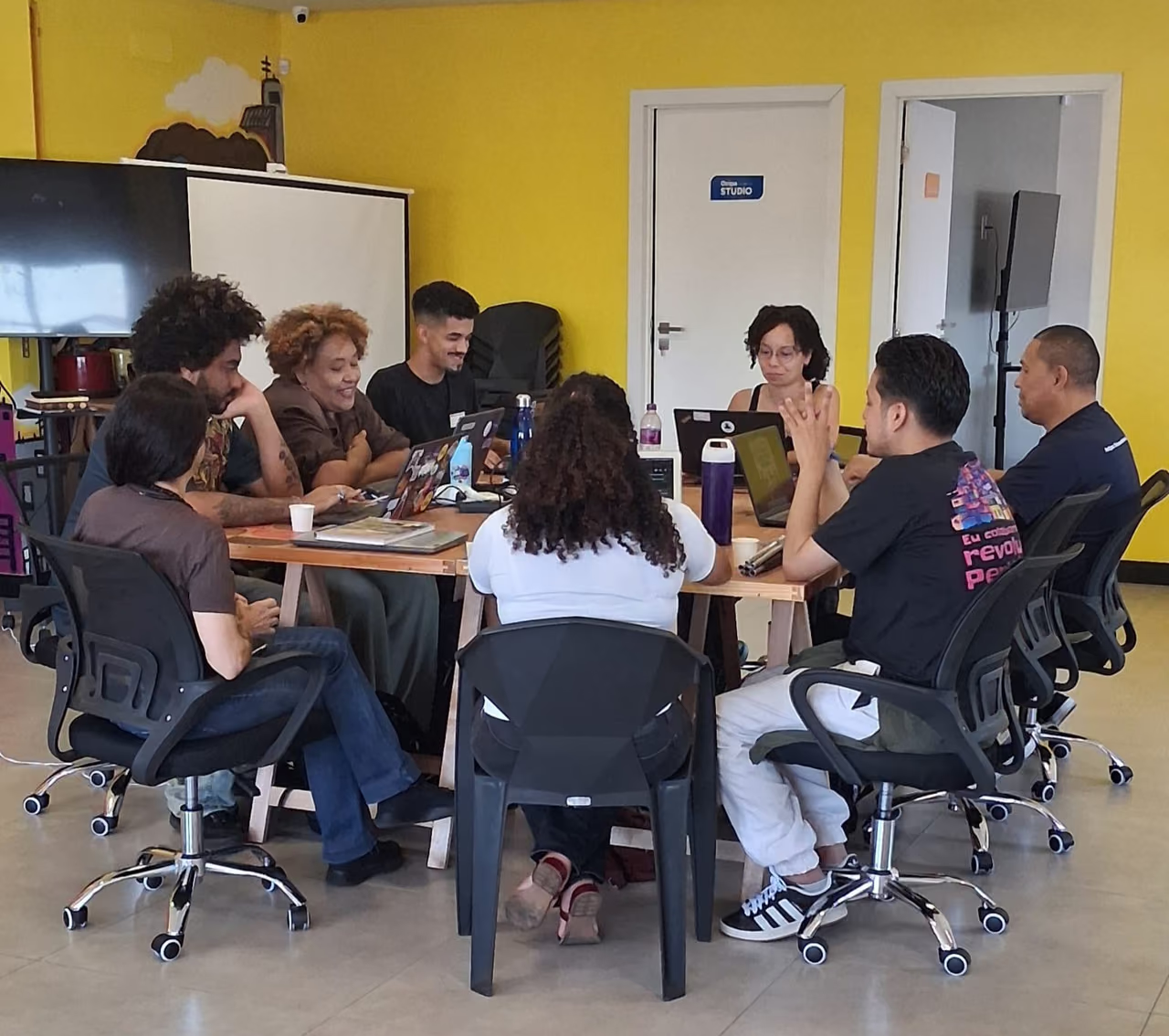
Before working on the Integração project, I already had a very strong concern about building horizontal management dynamics. I have worked with collectives for over ten years and have had the opportunity to participate in different organisational models, ranging from informal and formal collectives to local and municipal councils.
In many of these spaces, I encountered heavily verticalised structures, where processes stalled because the person responsible for the decision was not present or because a personal or institutional issue prevented a particular course of action from moving forward.
At the Hub Integração, I was able to experience the pains and pleasures of building shared governance from the writing of the project through to its execution. And one of the things I learned is that horizontality does not mean an absence of structure.
There are roles, responsibilities, delegated tasks and decision-making bodies. Not everyone decides on everything. There are also commitments that cannot be freely altered, such as parts of the scope agreed upon with the funder, which has its own governance bodies. The project must preserve its objectives and its purpose.
This understanding demands responsibility and dedication from all parties. And I am not just talking about hours worked or the quantity of tasks completed. I am talking about being on top of the dynamics, understanding the objectives, following up on the necessary actions and recognising that the work depends on a team.
If an organisation does not participate, if a team does not share information or if someone fails to assume an agreed-upon responsibility, the impact is not restricted to that person. It can compromise the work of other teams and, above all, the experience of those who should benefit from the project.
Therefore, when people ask me what is needed to build shared governance, my answer begins with a simple idea: sitting at the decision-making table in a horizontal circle is not enough.
It takes respect, transparency and a commitment to the project’s objectives. In our work, we translate this commitment into a guiding principle for decisions: Focus on the Beneficiary.
Before deliberating, we need to ask whether a given choice makes sense for the people and territories involved. What benefit does it produce? What impact might it generate? Is it contributing to what we committed to building?
Participating in a Shared Governance Committee means taking on the responsibility of speaking up, bringing ideas, listening to other perspectives and deliberating. It is not enough to be present and remain silent in the face of decisions that require participation. Nor is it helpful to continually question already established agreements without presenting alternatives or strategies that help resolve the issue.
Democratic governance does not eliminate disagreements. It must create the conditions for disagreements to be presented, discussed and addressed responsibly, without turning the space into an environment of personal conflicts or omissions.
Those who do not actively participate in democratic processes end up leaving the power and responsibility of deciding to others.
Building together is continuous work
The experience in the Active Citizenship Hubs has shown me that shared governance is not a ready-made structure that can be implemented and considered complete. It is a daily construction that depends on clear agreements, accessible information, active participation and a willingness to revise strategies when reality demands it.
Tools help. Minutes organise the memory, the RACI Matrix makes responsibilities clearer, management systems support monitoring, and methodological guides preserve learnings. But none of these tools replaces the commitment of people and organisations to collective work.
Perhaps this is the main connection between the reflection presented by Geraldo Barros and what I have experienced in executing the project. If his article invites us to look at the agreements that sustain a multi-institutional arrangement, everyday experience shows that these agreements need to be constantly practised, monitored and updated.
In the end, shared governance is not measured solely by the number of organisations involved or the number of meetings held. It appears in the quality of decisions, the transparency of relationships, the responsibility assumed by each party and the capacity to transform different experiences into a collective construction.
It is work that actively demands participation, listening and welcoming. It also requires understanding that no one builds a project of this scale alone.
And, above all, it requires us not to lose sight of why we decided to build together: so that people and territories are at the centre of decisions and are, in fact, the protagonists of the transformations we wish to achieve.