
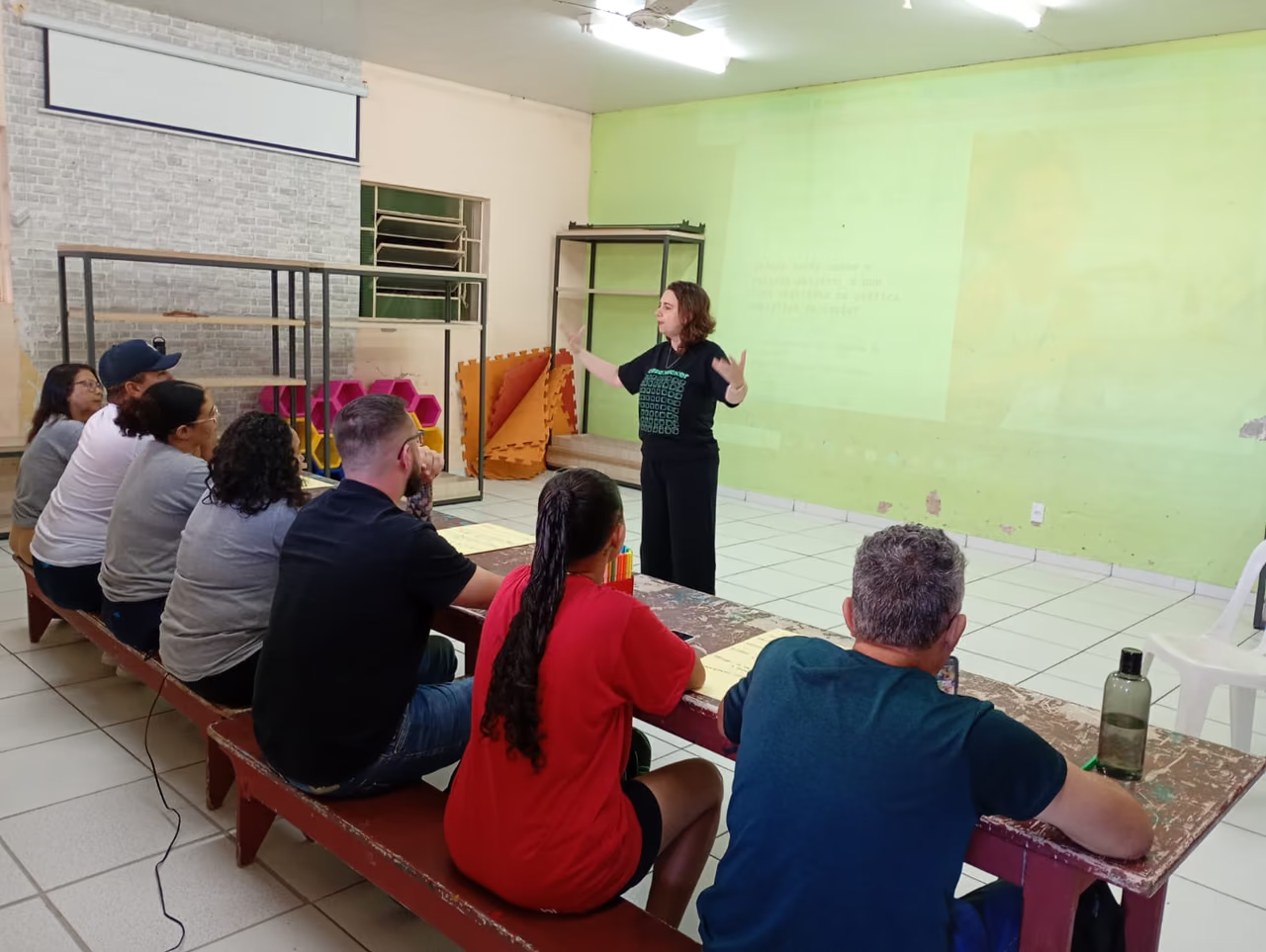
At Casa Hacker, we understand that education is also built upon our relationships with the territory where we live. It is in this sense that we have developed a training project with educators from an institution located in Vila Brandina, in Campinas. The work addresses three main axes: digital skills, digital safety and educommunication, seeking to support educators in building pedagogical practices that dialogue with the reality of the children and adolescents supported by the institution.
Educommunication bridges education and communication, recognising that educational processes involve ways of expressing ideas, sharing knowledge and producing meanings. From this perspective, communication is not limited to the use of media as resources for presenting content. It involves creating conditions for different people to narrate their stories, discuss issues that affect their lives and produce knowledge about the reality in which they are inserted.
Based on this understanding, our work was to support educators in building practices that articulate project-based learning, digital inclusion, digital safety and communication, taking the territory as a reference. The training sessions began with discussions on project-based learning and on how to organise proposals that stem from real issues, involve investigation and result in productions with a defined purpose.
Throughout the meetings, we worked on basic digital skills, digital safety and possibilities for producing communication pieces, such as videos, websites and posters. More than teaching how tools work, we sought to discuss how these resources could be used to research, organise information and communicate ideas. Digital safety was also addressed as part of this process, considering the necessary precautions when using technologies and sharing information.
Group of Educators in Training
Training educators for different age groups
A specific feature of the project was the diversity of ages served: the activities involved children from six years old and adolescents up to fifteen years old. This difference required the creation of proposals suited to the characteristics of each age group, considering the prior knowledge, forms of expression and learning possibilities of the groups.
Opinion research as a learning practice
To conclude the journey, the educators developed an opinion poll with the classes on issues related to the community. The work began with the choice of a theme, followed by the study of the subject, the drafting of the questionnaire questions and their application. Afterwards, the groups moved on to analysing the responses, seeking to understand what the data revealed about the investigated territory.
The final stage consists of producing a communication piece to present the results to the community. To do this, participants need to decide which information is important, how to organise it and what resources to use to make it understandable to the public. Socialisation is scheduled for the end of November and will be an opportunity to share the perceptions of children and adolescents about the place where they live, including what they value and what they consider needs improvement.
This stage makes it possible to put into practice the knowledge developed during the training sessions. Drafting the materials mobilises digital skills; organising and interpreting the responses requires critical reading of information; and producing the communication pieces demands choices regarding language, audience and purpose. At the same time, the research embodies the principles of project-based learning, as it starts from a question, involves different stages of investigation and results in a production that will be shared beyond the group.
The role of educators in collective construction
The journey also creates opportunities to reflect on the role of educators. In this process, they act as mediators, supporting groups in formulating questions, organising the investigation and interpreting results. This requires accompanying participants’ decisions, raising new questions and offering guidance without depriving them of the opportunity to actively participate in building the work.
The opinion poll, therefore, is not merely a concluding activity. It articulates the different contents worked on throughout the year and allows educators to experience a pedagogical proposal in which technology, investigation and communication are related. At the same time, it enables children and adolescents to produce knowledge about their territory and find ways to share it with other people.
Educommunication to understand and transform the territory
At Casa Hacker, we understand that working with digital skills goes beyond teaching the use of tools. It is also about expanding the possibilities of seeking information, interpreting reality and communicating what is learned. In the Vila Brandina project, this perspective materialises in the relationship between educator training and the development of research that starts from community issues.
By sharing the results, children and adolescents will have the opportunity to present their perceptions and contribute to the dialogue about the territory. For educators, the process represents the possibility of developing and evaluating practices that integrate project-based learning, digital inclusion and educommunication. Thus, communication ceases to be merely a resource used in activities and becomes part of the very process of investigation and knowledge production.
References
FREIRE, Paulo. Extensão ou comunicação? Rio de Janeiro: Paz e Terra, 1983.
FREIRE, Paulo. Pedagogia da autonomia: saberes necessários à prática educativa. São Paulo: Paz e Terra, 2011.
SOARES, Ismar de Oliveira. Educomunicação: o conceito, o profissional, a aplicação. São Paulo: Paulinas, 2011.