
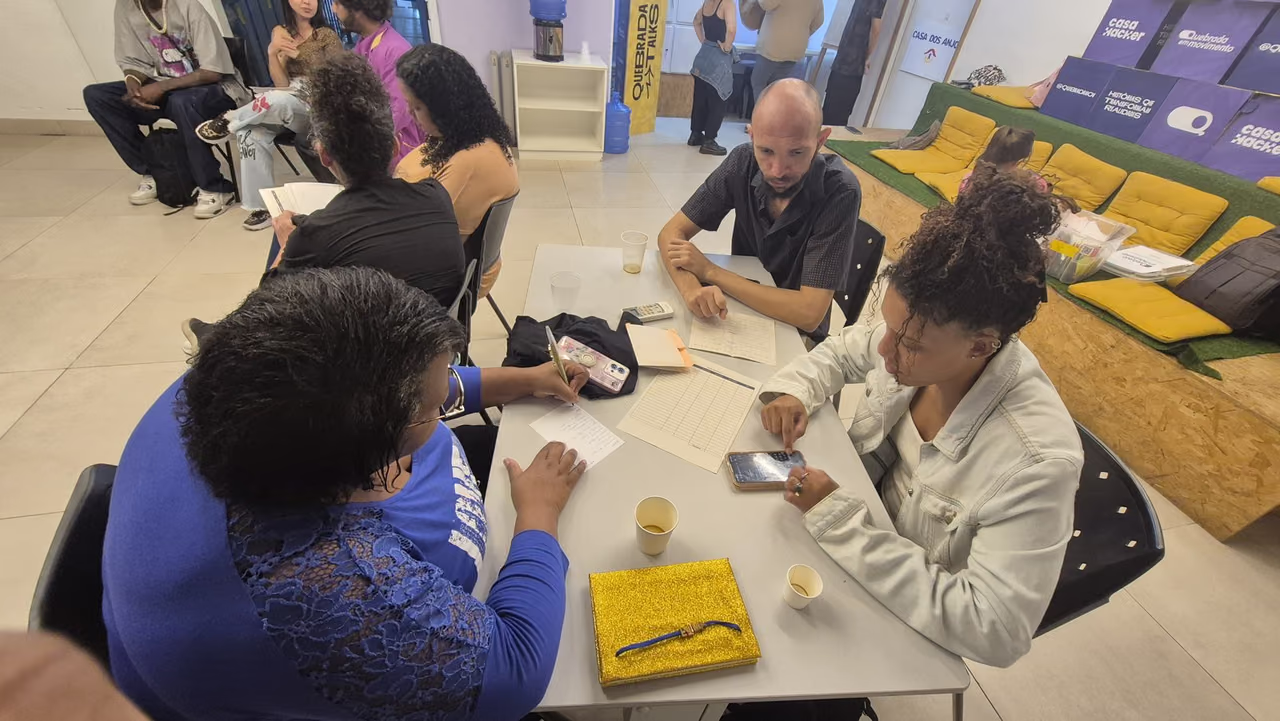
When we talk about technology and social transformation, it is common to think of major innovations, sophisticated platforms, or solutions developed to solve complex problems. But technology is also present in much simpler, everyday actions that can make a significant difference in the management of social projects, collectives, and community initiatives.
A WhatsApp group to organize a team, an Instagram post to publicize an activity, a digital form to handle registrations, or a spreadsheet to track participants are examples of tools that are already part of the routine of many organizations.
The use of these tools can facilitate processes, save time, and, above all, produce information that helps understand the results of the actions carried out. In this sense, technology is not just a communication tool. It can also be an ally in the management, planning, monitoring, and evaluation of projects.
From communication to management: technology in the daily routine of projects
The routine of a social project involves several tasks: mobilizing people, promoting activities, carrying out registrations, organizing teams, tracking participants, recording information, accounting for funds, and evaluating results. Many of these steps can be facilitated by digital tools.
A WhatsApp group, for example, allows quick communication between the team, participants, and partners. Instagram can expand the reach of an activity and reach people who do not yet know the initiative.

Registration platforms, on the other hand, allow organizing participant information even before an activity takes place.
These resources seem simple, but when used in a planned manner, they can significantly improve workflow. Technology, in this context, does not replace the human relationship that sustains social projects. It reduces operational tasks, organizes information, and creates conditions for teams to dedicate more attention to the development of actions.
Digital forms: more than a registration list
One of the most accessible examples of using technology in project management is digital forms. This resource can be used for much more than asking for a name, phone number, and email. Before an activity, it can help identify who the interested people are, which territory they come from, what their characteristics, experiences, needs, and expectations are. This information helps the organization get to know the audience it aims to reach better.
After the activity, a new form can be used to evaluate the experience and collect information about the results perceived by participants. In this way, the form ceases to be just a registration tool and becomes part of a data collection and organization process.
When data helps tell the story of the project
Imagine a collective that holds a training session for 50 people. Before the activity, the team provides a digital form for registration. At the end, they record attendance and send an evaluation to the participants.
From this information, it is possible to identify:
- Registrations: 50 people showed interest.
- Participation: 42 people attended the activity.
- Attendance rate: 84%.
- Audience profile: the team can identify, for example, which territories the participants came from and what characteristics make up that audience.
- Evaluation: participants can evaluate the activity and indicate what they learned, which contents were most relevant, and which needs remain.
These numbers do not tell the whole story, but they help build a more objective view of what happened. And this is a fundamental point: what is recorded can be analyzed. And what can be analyzed can contribute to more qualified decisions.
Measuring does not mean reducing impact to numbers

When we talk about metrics and indicators, there is an important caveat: social impact cannot be measured solely by the number of people who participated in an activity.
Having 100 registered participants can be a relevant result. But this number, by itself, does not answer whether the activity produced changes. Therefore, it is important to combine quantitative and qualitative indicators.
Quantitative data helps answer questions such as:
- How many people participated?
- How many activities were carried out?
- What was the attendance rate?
- How many territories were reached?
- How many people completed a training program?
- How many people returned for other activities?
Qualitative data, on the other hand, helps understand:
- What changed for the participants?
- What was learned?
- What knowledge was put into practice?
- What difficulties remained?
- What new opportunities or connections emerged?
- How could the activity be improved?
Numbers help gauge reach. Experiences help understand impact.
Comparing results to improve future projects
One of the great advantages of organizing data is enabling comparisons.
Imagine an organization conducting the same training at three different moments.
In the first edition, there were 30 registered and 20 participants. In the second, 45 registered and 38 participants. In the third, 50 registered and 44 participants.
By analyzing this data, the team can begin to investigate what changed: was the communication more efficient? Was the timing more appropriate? Did the format of the activity change? Was the audience mobilized by new partners? Was the registration process simpler? The comparison does not automatically provide the answer, but it offers clues for the team to investigate and make decisions.
Thus, monitoring results ceases to be merely an accountability obligation and becomes a learning tool.
How Hub Quebrada em Movimento uses data in daily life
At Hub Quebrada em Movimento, the use of digital tools is present in different stages of the processes developed with leaderships, collectives, and grassroots initiatives.
For us, this data is important to understand who the people and organizations arriving at the Hub are, what their needs are, what progress they are building, and what impacts are being produced throughout the processes.
An example is the selection and monitoring process of initiatives supported by public calls, such as the Fundo de Cidadania Ativa.
Based on the information presented by the organizations and collectives themselves, we are able to get to know the proposal, understand who is behind the initiative, identify how many people the collective intends to impact, and what results it aims to achieve.
This information is important not only to get to know the initiative at the entry point, but also to track its trajectory and understand its progress throughout the process.
Getting to know participants to build more appropriate training
This logic is also present in the training journeys carried out by the Hub.
Before the start of a journey, we use a registration form to get to know the people interested in participating: information such as age, gender, race, marital status, territory, experiences, and other aspects of the participants’ profile helps the team understand who is arriving for that training.
This data is not collected just to fill out a spreadsheet. It helps design a training journey more connected to the reality of the people participating in it.
Knowing the audience allows the team to ask important questions: what is this group’s prior knowledge? What experiences do these people bring? What challenges might be present? What adaptations might be necessary for the training to be more accessible and meaningful?
In this sense, collecting data is also a way of listening.
Entry and exit assessment: tracking transformation
Another important resource is comparing the entry point and exit point of people in a training journey.
Before the start, we can identify what the person already knows, what their experiences are, what challenges they face, and what expectations they have. At the end, we can ask again about acquired knowledge, tools used, perceived changes, and next steps. This comparison allows us to observe evolution throughout the process.
This does not mean claiming that all transformation can be explained by a single indicator. Human and community development is much more complex than that. However, having entry and exit data allows us to build evidence about the process and identify changes that, without this record, might remain only in the perception of the team or the participants.
Monitoring, therefore, is also part of the result.
Data must also return to the territory
There is still a fundamental dimension in this process: who is this data for?
The information produced by projects should not remain restricted to internal spreadsheets.
It can help the organization itself understand its work, allow participants to recognize their progress, let partners know the results, and enable other people to understand what is being built in the territories.
In the daily routine of Hub Quebrada em Movimento, data helps precisely to analyze the impact of the actions carried out in the territory and also to communicate this impact to people and organizations outside of it.
This feedback is important because it gives visibility to what often remains invisible.
A number can show how many people participated in a training. A set of indicators can show how many territories were reached. A report can show a transformation experienced by a participant.
When this information is organized and communicated, it helps build an evidence-based narrative about the work developed.
Data as a tool for transparency and accountability
Social projects frequently need to present results to partners, funders, public institutions, and the community itself. Having organized information from the beginning facilitates this process.
Instead of trying to reconstruct, at the end of the project, how many people participated or which activities were carried out, the team can track this data throughout execution. This contributes to more organized and transparent accountability.
It also allows demonstrating not only what was done, but who was reached, which activities were carried out, what results were observed, and what learnings emerged along the way.
Technology, people, and territory
Despite all these resources, it is important to remember that no tool, by itself, guarantees a good project. A form does not replace a good mobilization strategy. A WhatsApp group does not replace the building of bonds. A spreadsheet does not replace a team’s analysis capacity. And most importantly: an indicator does not replace listening to the people who participate in an initiative.
Technology works best when it is connected to well-planned processes and the real needs of the territories. It is this combination of people, knowledge, tools, and context that allows technology to be used strategically.
Strengthening management is also strengthening impact
In working with social projects, there is often a great deal of dedication to executing activities and little time available to organize information about what has been accomplished.
However, recording, tracking, and analyzing data can help organizations better understand their audiences, identify challenges, recognize progress, and plan next steps.
The experience of Hub Quebrada em Movimento demonstrates how simple tools can be part of different stages of a process: from identifying leaderships and collectives, through registrations and diagnostics of training journeys, to monitoring results and communicating the impact produced.
Project management is also part of this strengthening process.
When an initiative manages to organize its communication, structure its registrations, track its participants, and analyze its results, it expands its capacity to understand its own work and communicate its relevance.
From data to decision
Technology can be present at different moments of a project: before, during, and after an activity takes place.
Before, it helps with outreach and mobilization.
During, it facilitates communication and monitoring.
After, it allows you to organize information, evaluate results, and generate learnings.
However, the most important thing is not simply using digital tools. It is knowing why, when, and what to use them for.
Data only turns into information when it is organized and analyzed. And information only generates value for a project when it can contribute to a decision. Therefore, investing in digital tools can also mean investing in more organized, strategic management capable of learning from its own experience.
Technology, when put at the service of people and territories, can help not only to do more, but to better understand what is being done, for whom, and what transformations are being built.
In the end, measuring impact is not just producing numbers.
It is creating the conditions to see the path traveled, recognize progress, and make better decisions about the next steps.