
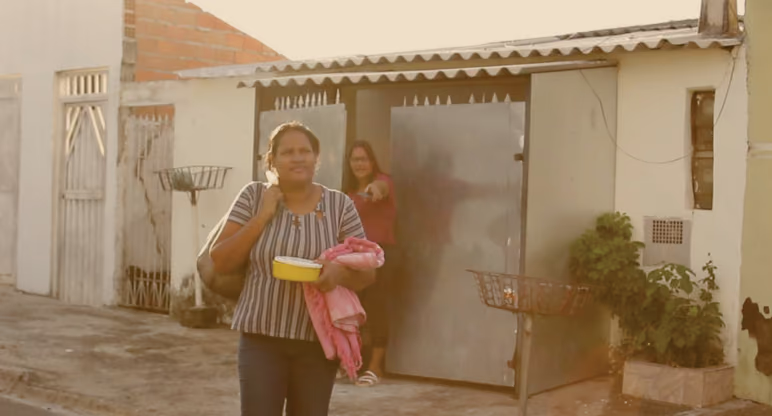
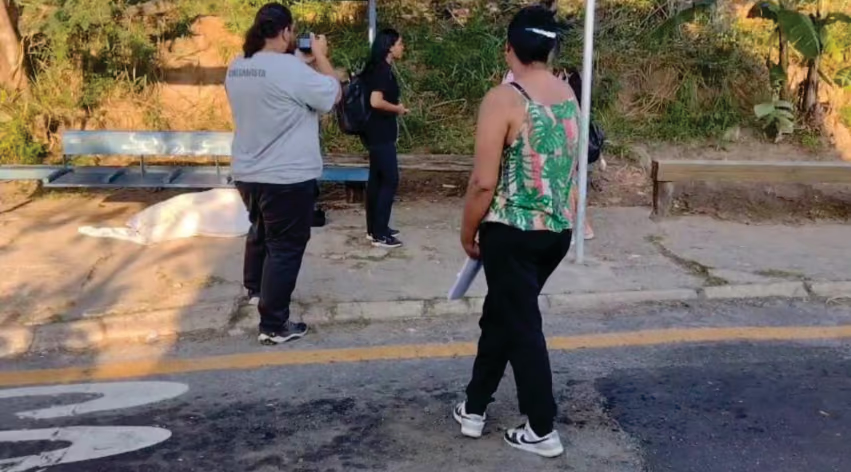
Participants of Cinema na Quebrada during the production of the short film A Limbosa.
The short film A Limbosa has not reached its final credits yet. Most of the scenes have been shot, but one more filming session and the editing still need to be done. Even so, before turning into a finished film ready for screening, the production has already fulfilled an important function: it put cameras, scripts, direction, and acting into the hands of residents from Campo Grande.
This experience began with the project Cinema na Quebrada: Criando e Compartilhando Narrativas Locais, carried out by Sociedade Cultural Art Asas with support from Fundo da Quebrada, within the Quebrada em Movimento program.
The proposal was to create an introductory cinema workshop for people aged 12 and over, stimulating creativity, independent cultural production, and the construction of narratives tied to the territory. During its execution, ten participants went through 11 theoretical and practical classes and took on different roles in creating a short film.
More than just watching films or learning concepts, they were invited to experience cinema from the inside out.
Learning cinema by making cinema
Art Asas already had experience with theater and the production of the short film A Pedra, previously carried out with incentives from the Lei Paulo Gustavo. Cinema na Quebrada, however, brought a new challenge: transforming this knowledge into structured training and sharing it with other people.
Classes covered cinema history, the evolution of cameras, script creation and writing, acting, directing, costume design, makeup, and equipment operation. After the theoretical part, participants were able to apply the content to produce a work created by themselves.
“They learned how to film, direct, act, and write scripts. They learned about costumes, makeup, cinema history, and the evolution of cameras.”
— Édio Vitorino Dambroski, from Art Asas
The proposal was not just to train actors or actresses. Participants learned about the different roles that exist in audiovisual production and assumed real responsibilities during the process.
The short film A Limbosa was written, performed, directed, and recorded by the students themselves, with the accompaniment of the Art Asas team. The activities transformed streets, houses, and other spaces in the territory into filming locations, showing that a cinematic production can also be born from the stories, resources, and landscapes existing within the community itself.
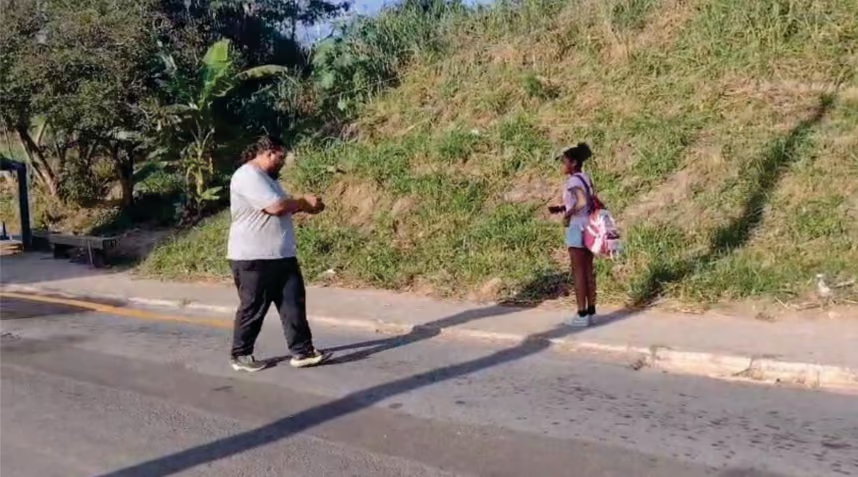
Participants during classes on cinema history, scriptwriting, acting, and camera operation.
When students take over production
One of the project’s main results was the autonomy demonstrated by participants during the recordings. With a short amount of training, they began to occupy roles that, before the workshop, might have seemed distant from their reality.
One of the participants took on the direction of the short film and led scenes shot in the neighborhood’s outdoor spaces. At one of these moments, while explaining to someone who was watching the activity that the group was producing a film, she became emotional when talking about the work and everything they had learned.
“I saw that she got very emotional when commenting on the film’s production, the work, and what they learned here.”
— Édio Vitorino Dambroski
This episode reveals something that doesn’t just show up in the project’s numbers. Producing a film meant being able to look at one’s own work and recognize that those people were not just attending a class: they were building a work of their own.
Evaluations carried out during the course also showed a good assimilation of the content. According to the technical report, all participants achieved positive results in the theoretical activities, while the recordings demonstrated their capacity for acting, directing, and equipment operation.
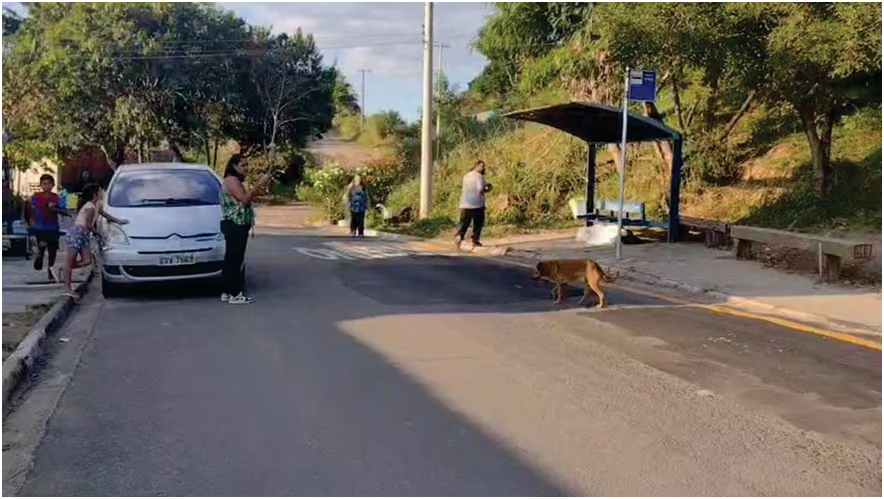
Behind the scenes of the scenes produced by the participants of Cinema na Quebrada.
Changes between planning and execution
As happens with many first-time projects, the planning needed to be adapted along the way.
The initial intention was to concentrate activities in a single space. Two classes were even held at CEU Mestre Alceu, but the difficulty of reconciling the public facility’s availability with the participants’ schedule required a change. The other activities were transferred to Art Asas’ own space.
Difficulties related to equipment also arose. The person who was initially going to provide part of the recording materials had to sell them due to health reasons. So that filming could continue, the team acquired, using their own resources, a lens compatible with a camera they already owned.
Putting equipment into the participants’ hands also required trust and preparation. Before starting the recordings, the team needed to teach the necessary care so that the cameras would be used responsibly. Initial apprehension was replaced by the realization that the students were able to apply what they had learned.
These adaptations were part of the experience of transforming a written proposal into concrete action, balancing space, schedules, equipment, food, participant monitoring, and audiovisual production.
A film that still needs to be completed
The project anticipated that the training process would end with the finalization and screening of the short film. The film would also be made available on social media, expanding the initiative’s reach beyond the workshop participants.
This stage has not been reached yet.
In the technical report, produced at the end of the execution period, A Limbosa appeared in the production process, with a later premiere scheduled. In the interview conducted afterwards, the team explained that one scene still needed to be shot and the editing done.
Since the proposal was for the students themselves to lead the production, the interruption of part of the group’s participation also interrupted the film’s progress. Some decisions and scenes depended on the presence of the participants, and personal issues ended up hindering continuity.
The Art Asas team is studying inviting other people to complete the cast and finish the work. At the same time, they recognize that the experience brought lessons on how to conduct future training.
“If I were to do it today, I would take on general direction to provide greater support and help the students bring the film to fruition.”
— Édio Vitorino Dambroski
This evaluation does not take away the participants’ protagonism over the creation. It points to the need to balance autonomy and monitoring, ensuring that students occupy the roles of a cinematic production without being left alone to face difficulties that might prevent the work from being completed.
Results that exist before the finished film
The fact that the short film has not yet been completed prevents part of the anticipated results from being considered achieved. The public screening session did not take place, and the estimated indirect audience, which would have been reached through the film’s circulation on social media, has not been mobilized yet.
On the other hand, the project held 11 classes, directly benefited ten participants, and enabled a practical experience of audiovisual creation. Students studied, wrote, acted, directed, and operated equipment during the production of a collectively built work.
Another result was the systematization of a workshop format that can be perfected and carried out in other places. Before Cinema na Quebrada, the Art Asas team had not yet conducted specific cinema training with this structure. After the experience, conversations and proposals began to emerge to take the course to other territories and organizations.
This first workshop helped the team better understand the time needed for a production, the risks of depending on the availability of the entire cast, and the importance of establishing general coordination capable of accompanying the film until its completion.
Thus, the learning was not restricted to the students. Art Asas itself left the project with more repertoire to plan, teach, and conduct future audiovisual training.
The resource as a possibility for experimentation
Cinema na Quebrada received R$ 2,500 from Fundo da Quebrada. The support was intended to fund workshop facilitation, transportation, food, editing, and the creation of visual identity and promotional materials.
During execution, some expenses needed to be adjusted. The anticipated food was not enough for all meetings and recordings, some receipts were lost, and the purchase of the lens needed to continue production was not part of the original budget, being supplemented with own resources.
Dealing with the resource and accountability was pointed out by the team as one of the most challenging parts of the experience. The accompaniment of Casa Hacker and Quebrada em Movimento was important to guide questions and bring more security during execution.
In this sense, the resource did not just serve to pay expenses. It allowed Art Asas to test a new proposal, structure its first cinema workshop, and discover, in practice, what would need to be kept or modified in a future edition.
From Fundo da Quebrada to Fundo de Cidadania Ativa
The experience of Fundo da Quebrada currently continues through Fundo de Cidadania Ativa, whose projects contemplated in 2026 are in the execution phase.
The continuation of this strategy reinforces the importance of combining financial resources, training, and monitoring. The experience of Cinema na Quebrada shows that developing a community initiative also means dealing with unforeseen events, reviewing choices, recognizing what was not completed, and transforming these difficulties into knowledge for upcoming projects.
The short film A Limbosa still needs to be finalized. But the people who participated in the process have already experienced different stages of filmmaking and tried out the possibility of telling a story with their own words, bodies, images, and territories.
Even before the final credits, Cinema na Quebrada set something important in motion: the perception that residents do not just need to appear in front of the cameras. They can also write, direct, and produce the narratives they want to see on screens.