
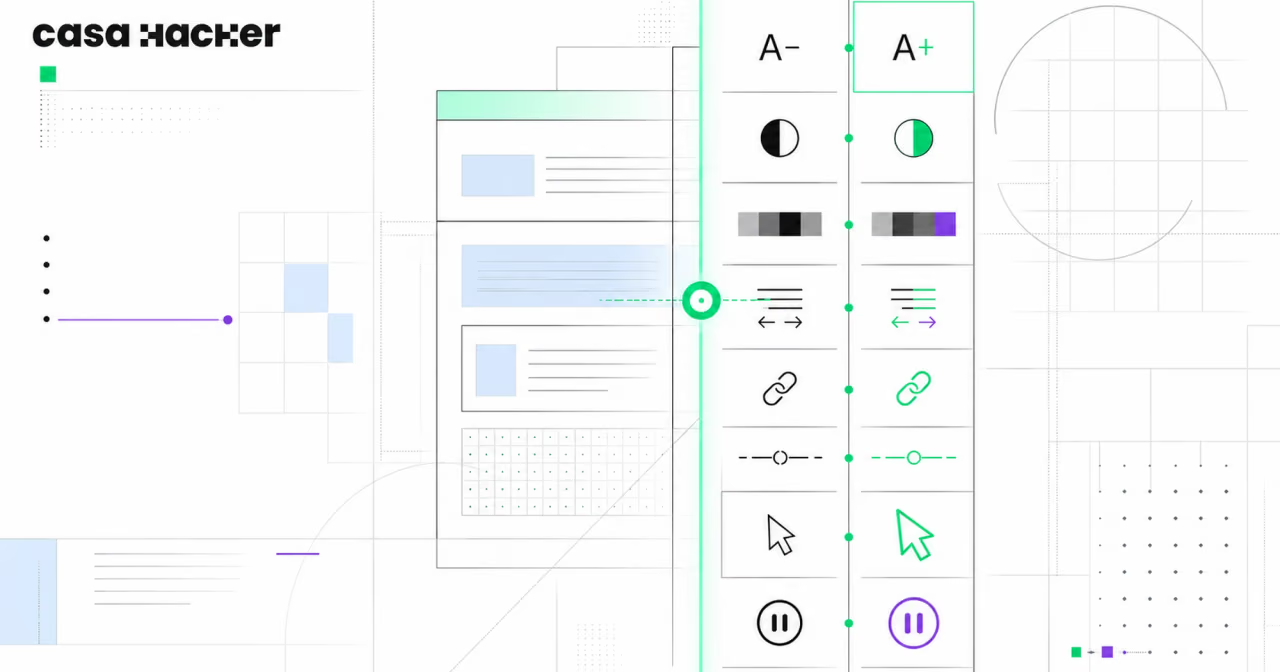
A few years ago, I worked on open-source projects like WebCompat at Mozilla. WebCompat alerted developers worldwide when their websites did not follow development best practices — meaning, when they weren’t compatible or inclusive. I also collaborated with the Fedora Project. In all these places, diversity and inclusion always brought challenges. They can start from physical limitations, like blindness or reduced mobility, but they also involve different languages, distinct time zones, and nowadays, neurodivergent people, for example.
Inclusion is built in the details
Here at Casa Hacker, over the last few years, we have invested in several inclusion initiatives. We conducted training with the team to make our activities accessible to everyone — not just people with disabilities. A simple example: in a Hackerclubes activity, when the facilitator speaks and also writes a summarized version of what they just presented, that is an inclusive act. Not everyone processes what they hear instantly, and text allows people to review the content during class. It is small practices like this that make daily work truly inclusive, and details matter a lot — from a wheelchair ramp to Libras interpretation.
We also updated the platforms we use and removed those that did not offer accessibility, including for our team and the Casa Hacker member community. We started hiring services like audio description and Libras for activities, communication, and media, and we created an internal policy: upon joining Casa Hacker, each person is asked if they need any accessibility resource to fully participate. Based on that, we plan our actions. In Hackerclubes, for example, neurodivergent people receive dedicated support during meetings, integrated into the group.
The news: our accessibility bar
Now, I want to introduce a new feature: our accessibility bar. Many websites already have features like this, but we discovered we can deliver much more. We developed the bar’s code and are standardizing these features across all Casa Hacker platforms, including this website — you can find it fixed at the top of this page. They are reading and navigation features: high contrast, font size, dyslexia-friendly font, reading ruler, focus mode, enlarged cursor, animation pause, larger click targets, underlined links, and translation to Libras with VLibras, the official translator maintained by the Brazilian government with the Federal University of Paraíba. The complete features are listed at casahacker.org/acessibilidade.
And we made sure of a detail that often goes unnoticed: the bar itself must be accessible. It works entirely by keyboard, has touch targets the size that international accessibility guidelines (WCAG) recommend, and measured contrast — because it makes no sense to offer inclusion through a tool that excludes.
Open for anyone to use
In our manifesto, we made a commitment to treat technology as a right and as a language of power, not as a privilege for the few. This right includes how you access it: technology that only works for those who see well, hear well, and navigate fast is not a right — it’s a barrier. Therefore, with this commitment to make the internet more inclusive, we are opening our technology as open source, with a free license (MIT), so that anyone can prepare their content to be read and accessed inclusively.
The code lives at gitlab.com/casahacker/barra-acessibilidade, with technical integration documentation and automated accessibility tests. Just download two files from the latest version and serve them on your own website — without relying on a third-party service. And, like any open project, it improves with those who arrive: suggestions, corrections, and translations are welcome there.
A website that speaks more languages
Beyond the bar, we are also attentive to the people in our territory who came from other Latin countries, like Venezuela and Haiti — from Jardim Bassoli to Jardim Florence, and also in Jardim do Lago. That is why we translated the website into English, Spanish, and French, allowing both our partners in Latin America, Europe, and the United States and the people from our territory who came from other countries to get to know Casa Hacker and what we do here.
When Casa Hacker was born, it was born alongside the certainty that the peripheries are not a place of waiting — they are a place of beginning. Accessibility is precisely that in practice: ensuring no one is left waiting outside while the future is being programmed. The bar is yet another one of these beginnings, and now it belongs to everyone.