

When we talk about STEAM Education, it is common to immediately think of what happens inside the classroom: students building prototypes, programming, experimenting with electronic components, 3D printing parts, or developing projects that articulate science, technology, engineering, arts, and mathematics. But for all of this to happen, there is work that begins long before the first workshop.
The implementation of a STEAM Education program in a public school involves listening, planning, articulation with different actors, student mobilization, dialogue with families, resource organization, and the construction of a pedagogical proposal connected to the reality of that territory.
It is from this understanding that Casa Hacker has been developing Hackerclubes, a program that seeks to democratize access to STEAM Education and expand the possibilities for youth from peripheral territories to know, experiment, and occupy spaces related to science, technology, and innovation.
Before entering the school, the path must be built
The choice of school is not just a logistical decision. It is part of the program’s action strategy. Hackerclubes operate primarily in public schools because we understand that these spaces hold an important portion of the youth we want to reach. The school is therefore a strategic point to democratize access to STEAM Education, bringing students closer to experiences that are often not available in their daily lives.
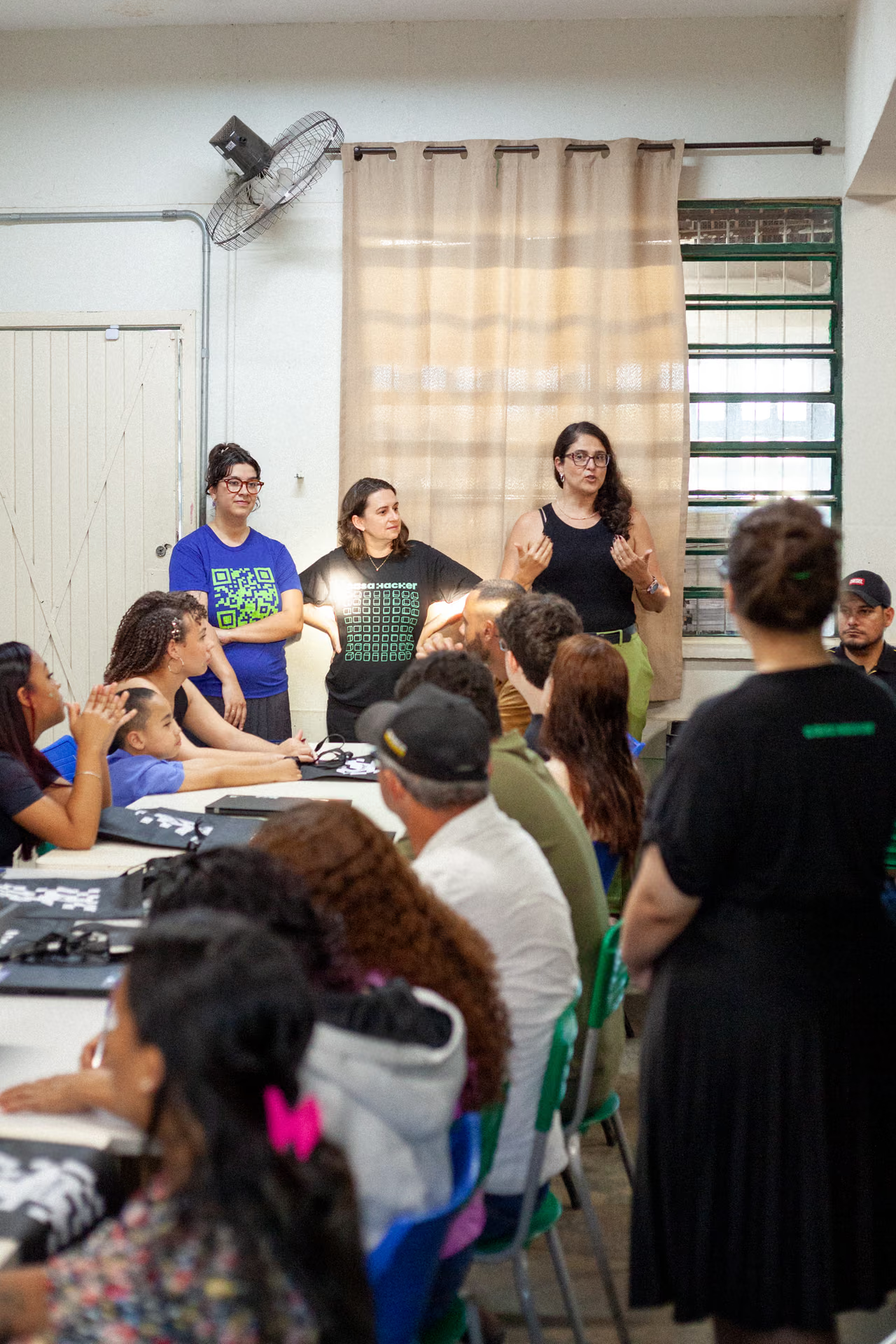
However, entering the school requires building a relationship with those already in that territory. Before activities begin, we hold alignment meetings with school management and pedagogical coordination. We present the proposal to teachers, discuss the school’s routine, identify possibilities and limits, and seek to understand how the program can integrate into that context. This process is essential because no project arrives at a school on an empty territory. There is a community, a school culture, a routine, professionals, students, and families. Implementation must dialogue with all of this.
Mobilization is also part of the pedagogical proposal
Another fundamental moment happens before training: student mobilization. In Hackerclubes, we do not start from the idea that students need to arrive at the project already interested in technology or have good performance in math and sciences. On the contrary. One of the program’s functions is precisely to create the opportunity for them to discover new interests and possibilities. Therefore, we hold mobilization workshops inside the schools. These are moments when students can learn about the project, experience a bit of the proposal, and decide if they want to participate.
Registration happens based on interest and the desire to learn, rather than high grades or prior knowledge. This choice is especially important when we think about equity. If we demand that youth already be familiar with technology to enter a STEAM Education program, we run the risk of reproducing the very inequalities we want to combat. Mobilization, therefore, is not just a dissemination step. It is the students’ first contact with a new learning possibility.
Persistence begins before the first class
Ensuring that a student manages to enter the project does not necessarily mean ensuring they will manage to stay.
For this reason, care regarding persistence begins right in the selection process. Especially when working with girls, we talk with students and guardians to understand the conditions of participation and align expectations. Issues such as domestic responsibilities, caring for siblings, commuting, and routine organization can directly interfere with the possibility of staying in extracurricular activities.
This dialogue allows us to identify obstacles before they turn into dropout rates. More than just filling a classroom, our goal is to create conditions so that students can participate effectively, build bonds with the project, and recognize themselves as protagonists of their own trajectory.
Management is part of the educational experience
Behind every meeting, there is also a management process that must connect strategy, budget, partners, and the pedagogical proposal.
In Hackerclubes, we seek to work from three dimensions: clarity on the action strategy, alignment with the pedagogical project, and understanding of the reality and potential of the audience we want to reach. This means that administrative decisions are not separate from the educational experience.
The organization of resources, the hiring of professionals, the availability of equipment, the planning of activities, communication with the school, and the monitoring of students must be articulated so that the pedagogical proposal happens in a qualified manner.
We also seek to ensure that available resources are directed primarily to the execution of the project and the needs of the students, keeping the training free and expanding access conditions.
A STEAM proposal connected to reality
The work of Hackerclubes is the result of a trajectory of experimentation and learning by Casa Hacker. The pedagogical architecture was built from the experiences accumulated in previous initiatives, such as Minas em Tech, and from the understanding that technology needs to be linked to concrete problems, interests, and possibilities.
The proposal starts from project-based learning and seeks to connect technical knowledge to real-life situations. Students come into contact with content such as electronics, programming, 3D modeling and printing, augmented and virtual reality, and digital security. This knowledge is mobilized in the construction of projects that also dialogue with the Sustainable Development Goals and, in the new Hackerclubes, with the relationship between Urban Art and Technology.
The idea is simple, but it requires consistent pedagogical construction: the student should not just learn a technology. They need to understand what it is for, experiment, create, make mistakes, test again, and realize that they can use it to produce something of their own.
What we are trying to build
The experience of Hackerclubes is also related to a broader ambition of Casa Hacker: to contribute to the construction of a STEAM Education ecosystem geared toward the needs of peripheral territories.
Partnerships are fundamental in this process, but an ecosystem is more complex than a partnership between organizations. It presupposes a shared purpose, articulation between different sectors, representativity, inclusion, governance, communication, and the capacity to make data-driven decisions.
It is in this sense that each new Hackerclube represents more than the opening of a new class. It represents the opportunity to test ways of doing STEAM Education that consider the concrete characteristics of each territory and, at the same time, systematize learnings that can strengthen the program as a whole.
From first contact to the possibility of a new future
The results of previous experiences show that this process can produce effects that go beyond the learning of technical contents.
Throughout Casa Hacker’s trajectory, students have developed digital competencies, expanded their contact with different technologies, and learned about professional possibilities that were previously not part of their horizons.
Practical experiences, technical visits, meetings with professionals, and project development help transform what might seem distant into something concrete and possible.
In evaluations carried out within the scope of previous experiences, 100% of students stated they felt more prepared to pursue a career related to STEAM and innovation. This result helps reinforce a central idea: democratizing STEAM Education does not just mean teaching technology.
It means expanding repertoires, strengthening students’ confidence, and creating opportunities so that youth who have historically had less access to these spaces can also imagine themselves as people who create, research, develop, and work with science and technology.
Invisible work is also part of innovation
When a group of students begins an electronics or programming workshop, what shows is the tip of a much larger process. Before that first class, there was articulation with the school, planning, mobilization, dialogue with teachers, students, and families, organization of resources, selection of educators, and the construction of a pedagogical proposal appropriate for that audience.
This prior work is not bureaucracy that precedes innovation. It is part of innovation itself. The experience of Hackerclubes shows us that a STEAM Education program committed to equity needs to look at the territory before looking at technology. It needs to understand who the students are before simply defining what they will learn. And it needs to build, together with the school, the conditions for the experience to be possible and meaningful.
It is this set of choices that transforms the arrival of a program at a school into an educational experience capable of opening new paths.
Because, in the end, the goal is not just to put more youth in contact with technology, but to make them realize that they can also occupy this space.
Written by:
Amanda Santos, STEAM Program Manager Aliene Villaça, STEAM Program Pedagogical Coordinator