
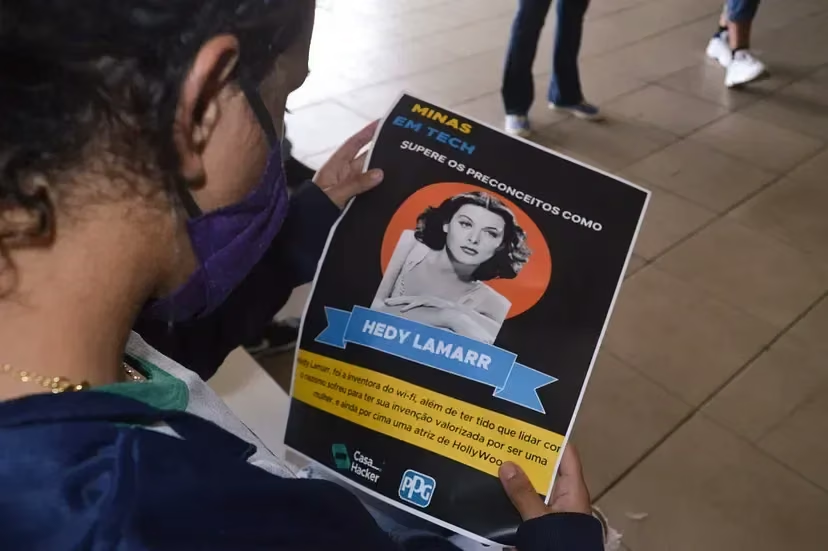
Happy Women’s Day to all, and especially to Brazil’s few women scientists.
By Renata Neves
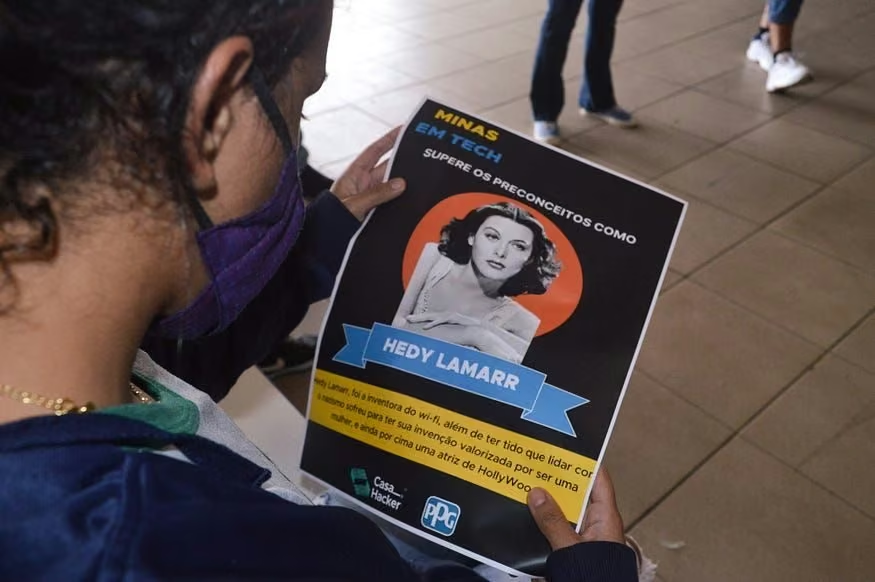
Source: Casa Hacker
A child at school learns from early on that they should choose a profession to “be when they grow up”. Generally, the choice of career is free for these small dreamers, but for girls there are always limitations between the dream, the support and the knowledge.
This means that the possible professions for girls are restricted to what they already know or have heard about from other people.
By the end of secondary school, they settle for dreaming of what has already been presented to them, without knowing that they could explore skills or sectors that lack the presence of women.
The fields of technology, innovation and entrepreneurship, for example, are places where it is common to see men in leadership or making up most of the teams.
One of the side effects of this situation therefore falls directly on that seven-year-old girl who cannot ask how to go about working with robotics, since by common sense she would not fit in.
Indeed, the absence of a female presence associated with these creative sectors limits the thinking of young women, as well as causing unease about the future.
With a more equitable future in mind, Casa Hacker and PPG Brasil developed the Minas em Tech project, aimed at secondary school girls diving headfirst into technology.
So, on this Women’s Day, we want to encourage you to find out more about the project and the full significance of its impact.
Shall we?
What are the dreams of a secondary school girl?
We have already been through great changes in innovation, in technology and even in global health, yet every year countless studies point out that women are missing from careers in the exact sciences.
In 2020, Inep noted that 59% of university students are women, but only 41% take courses in the exact sciences. And in 2019, the United Nations (UN) revealed that only 24% of the women who work in Brazil pursue a career in STEM (science, technology, engineering and mathematics).
These and other studies have already understood that efforts to bring women into the technology market begin at school.
When a social construct defends the separation of roles between men and women, we suffer a significant loss of young girls interested in science.
Bruna da Silva Santos (16), a student on Minas em Tech 2022, says: “I didn’t know about the technology side (about careers), but the course showed me lots of things that really sparked my interest. Before, I only thought about going to university, but now I want to learn about all the other kinds of technology so I can specialise in one of them.”
Starting in childhood, at least the possibility of working with innovation passes through girls’ minds.
Then, later, they are limited and defined as “less able” for the exact sciences. Just as the mechanics of cars are supposedly to be handled only by men, or the analysis of a smartphone’s hardware is asked of them alone.
On the other hand, there is always that girl who stands out from the crowd and takes an interest in artificial intelligence from secondary school onwards. What is the path this girl should take from now on?
Every answer to this question comes with limitations and obstacles. It is possible that her family will not encourage her ideas, that the school will not recognise her potential, or that other professionals in the field will discourage her.
Nicolly dos Santos Alves (18), a student on Minas em Tech 2022, says that when she was younger she liked watching programming, but she never found a course that interested her.
Projects like Minas em Tech emerge with the main aim of listening to these young women and, in doing so, creating a base of knowledge so that they can understand their own tastes and abilities.
The pursuit of greater equity in technology
The technology sector is not the only one that needs to worry about gender inequality, but it is one of the fields that clearly shows the imbalance.
Nicole Santos Chaves (16), a student on Minas em Tech 2022, shared: “My uncle worked with computers and I found it really interesting, and I already liked watching videos about puzzles involving programming, but I had no idea how far technology reached and I didn’t imagine myself following that career.
Before, my career plans involved medicine, like paediatrics and nutrition. These days I haven’t stopped liking the nutrition field, but I’ve thought about several others, like scientist, biologist or programmer. I’ve even thought about using 3D modelling and printing for sales.”
Many female university students drop out of their course because they are a minority, because they are silenced or because they are underestimated. On top of that, the financial gap between men and women can create even greater barriers to studying.
The STEAM coordinating teacher Aliene Villaça adds that “It’s still very visible; when we look at an undergraduate course, the difference in the presence of men and women leaps out. Even though it has improved, it’s still very striking. A woman’s presence has to reassert itself all the time; she has to prove her worth all the time as a professional. Even though we see progress, the inequality is definitely still there.”
While technology and innovation are here to make people’s lives easier, on the other side there are minority groups — such as women, Black people, LGBTQIAP+ people and others — who cannot take part in that evolution.
As a result, Brazil remains in this limbo of research or creations always aimed at a single group.
That means that if it is not possible to find solutions to problems for all Brazilians, it is quite possibly because there is not enough representation to do so.
According to the coordinator, “STEAM can be a great tool for encouraging more women and girls to consider that possibility (about a career in technology). On last year’s Minas em Tech, there were many girls who had never even considered it.
If I don’t know that something exists, it doesn’t become a possibility for me. If I don’t know there’s another possibility for me, it starts to make sense. It’s common for girls to choose careers they are used to seeing.”
In pursuit of equity, Minas em Tech decided to use the STEAM education approach, which resulted in the girls’ genuine participation and interest in the exact sciences.
Through discovery and practical knowledge, the girls gain more confidence in a safe environment. Which is already a huge first step towards facing the job market.
On the experience of carrying out a project, Nicole Santos says: “I chose to work with the girls who weren’t so close to me because we’d already been told that when we go to work somewhere we’d have to learn to deal with new people, and so I did it and I don’t regret it. I had a lot of new experiences working with them.”
Minas em Tech
One of the greatest aims and challenges of this social project is to reinforce gender equity in tech.
For that, beyond well-planned content, it is necessary to foster a safe environment, to understand the process of identification and the feeling of belonging, to work on the emotional side and to make it easier to meet other people.
Nicolly reports that “Minas em Tech wasn’t just a course in the technology field. It was something that taught us about self-knowledge, about being patient, about socialising, and taught us to be flexible about certain things.”
All of this was structured and planned by the teachers Isabela Gonçalves (Gender Projects coordinator), Vivian Costa (STEAM teacher) and Aliene Villaça (STEAM coordinating teacher)
This team of brilliant women from Minas em Tech have also been through the difficulties the girls will face in the job market.
The teachers therefore stop being merely a figure of knowledge and learning and become a real model for making dreams happen. Unlike an ordinary school, where the teacher is a distant adult who can sometimes be a role model but is generally just part of a larger system.
And having real people in whom the girls can place their trust is essential for transforming a career.
In this situation, they come to realise that it is possible to follow other paths, that they can have their own personal achievements and that they can also be an inspiration for other generations.
Aliene points out that “When we put them in a space where they have a voice, where they can say what they think, meet other women, run tests and develop their own project, that brings the student a process of identification and belonging.
What was once an ‘I’ll never do that’ starts to be questioned as something they might be interested in and could carry out.”
The participation of other women working in the market or doing research also helps the process of representation. It is important that each student has her own model of identification and understands that she is not alone on this journey.
Bruna da Silva stresses that “The course had a huge impact on my life; it showed me several fields I can go into, not only the usual areas of work but also areas of technology such as artificial intelligence, physical programming, code developer and others.
It also had a big impact on questions of friendship and confidence. There I found people who really want to help with that; I had lots of experiences with the company visits, with the events.
So it had a great positive impact, especially the teachers, who helped me a lot, and I can only thank them for showing me all of this,” she adds.
STEAM education in practice
Let us understand a little of what the STEAM approach is, which the coordinator Aliene mentioned and which seems to be very important for Minas em Tech.
The concept of STEAM comes from the acronym Science, Technology, Engineering, Arts and Mathematics and should be understood as an interdisciplinary approach that integrates science, technology, engineering, arts and mathematics for students at any level.
STEAM was studied as two big questions emerged: first, how to increase the number of qualified professionals in the exact sciences and, second, how to encourage younger students to study and take an interest in these more “feared” subjects?
So, in 1990, in the United States, the proposal for STEM appeared, and years later it was updated to STEAM as a solution for the rapid development of new skills and critical thinking.
Students are encouraged to investigate, discover, connect, create and reflect, as many times as necessary in their projects.
Because of that, a student comes to have a natural interest in the subjects, as well as understanding why the content is needed.
The STEAM coordinating teacher, Aliene, explains how the approach works within the project. According to her, “At Minas em Tech, we have content that forms the base guiding our curriculum: we have content on electronics, programming, artificial intelligence, 3D modelling and printing. STEAM, then, comes in as a way of showing that knowledge in practice.
We use the approach and its methodology in the project work. They are small projects and actions that have to be worked on in a group and discussed. The aim is to develop something that has sense and meaning for them, but based on the lessons they are learning.
At the end of the course, a bigger and more robust project is developed that involves the SDGs (Sustainable Development Goals) and that involves their own reality.”
For example, the students Bruna da Silva and Nicolly dos Santos Alves developed, with their group, the combination of a temperature sensor with a heart rate sensor after making observations about the health centres in their neighbourhoods.
According to Nicolly, “We thought of it because of the problems with Covid and we realised that most of the symptoms could be picked up through body temperature and heart rate. So very often people on low incomes don’t have an instrument to check that and end up going to the emergency unit. The problem is that the emergency unit always takes longer, so we created this alternative to speed up the care there.”
The student Nicole Santos Chaves, with her group, made a hand prosthesis that would open and close according to the signals from the arm muscle. “We went through ups and downs and got discouraged when we found it too difficult, but the teachers helped us and that way we managed to finish the project,” she says.
“I don’t regret doing Minas em Tech at all; I did it out of pure interest of my own and today I feel much more confident about a lot of things — it was a great experience in my life,” she adds.
You can also read about other projects developed in 2022 by clicking the link here!
It is important to stress that, for STEAM education, “It’s not knowledge having more value than the project, but rather content in the service of the project they are developing,” as Aliene puts it.
Tips for those who like innovation
Of course it is common to wonder whether a career in technology is really for you or not.
In fact, Minas em Tech also welcomes girls with more doubts than certainties, but if you are still unsure about your tastes and wishes, there is always the internet to save us.
The Escola Virtual of the Fundação Bradesco offers a number of short courses to explore. Through them, you can start to identify whether there are subjects you like or are curious about.
You can also get to know PrograMaria, a course aimed at women that tackles gender inequality in the field of programming.
These tips were sent by the coordinator Aliene, and you can find more options or get to know other incredible women such as Nina Da Hora and Carla of Física Preta.
And if you are a teacher, a scientist, someone working in the field or a volunteer interested in helping us, send a message to our team at minasemtech@casahacker.org or send a message on WhatsApp to (19) 99699–1534.