Projects, in general, are taught and structured based on a very objective logic: beginning, middle, and end. There is a period to plan, another to execute, and, at the end, it is necessary to present results, evaluate what was accomplished, and close the cycle. This logic is important, especially when we talk about resource management, responsibilities, schedules, and assumed commitments. But when the objective of a project is to contribute to transforming social realities, this temporal logic begins to present some limitations.
A social transformation hardly happens within the same timeframe as a project. Processes are longer, crossed by different factors, and often unpredictable. A training program may last a few months, but the knowledge acquired by a leader can be applied for years. Financial resources may enable an initiative at a given moment, but their effects may appear much later. Collaboration among organizations may begin during a project and generate new possibilities when the project has already ended. Therefore, it may be necessary to differentiate the time needed to execute a project from the time needed to produce a change.
This reflection gained a very concrete meaning for me recently when I revisited a folder called “plans 2025_26”. It gathers some of the documents we produced during the second quarter of 2024, when we began building the project we are now executing in the Active Citizenship Hubs. During that period, we met weekly to discuss the proposal, organize ideas, build the planning, establish objectives, define activities, and think about how that strategy could contribute to strengthening the territories.
Revisiting those files almost two years later was an interesting experience. Amidst so many documents, I found plans that remain quite close to what we are doing today. The training journeys that were conceived at that time are happening. The financial support call is being executed. The integrated mentoring program is part of the initiative monitoring strategy. The collaborations among the Hubs continue to be built. What in 2024 was an intention organized in documents has become part of reality.
This experience made me think less about meeting a schedule and more about the role that long-term planning can play in impact projects.

A group of participants gathered around a table during a collaborative work activity, with notes and sticky notes scattered across the space.
This is where the Theory of Change becomes an important tool.
Casa Hacker has a Theory of Change that seeks to make explicit its understanding of how transformation happens and which paths can contribute to sustaining it. One of its premises is precisely to recognize that change is not linear, but complex, multifaceted, and interconnected.
This premise sounds simple, but it has important consequences for how we think about and execute projects.
When we build a schedule, we organize actions in a sequence. First one activity, then another, then another. When we build a Theory of Change, we are trying to understand a broader relationship: what conditions need to exist for a given transformation to be possible? What role do our actions play in this process? What results do we hope to produce in the short and long term? And what are the external factors that also influence this change?

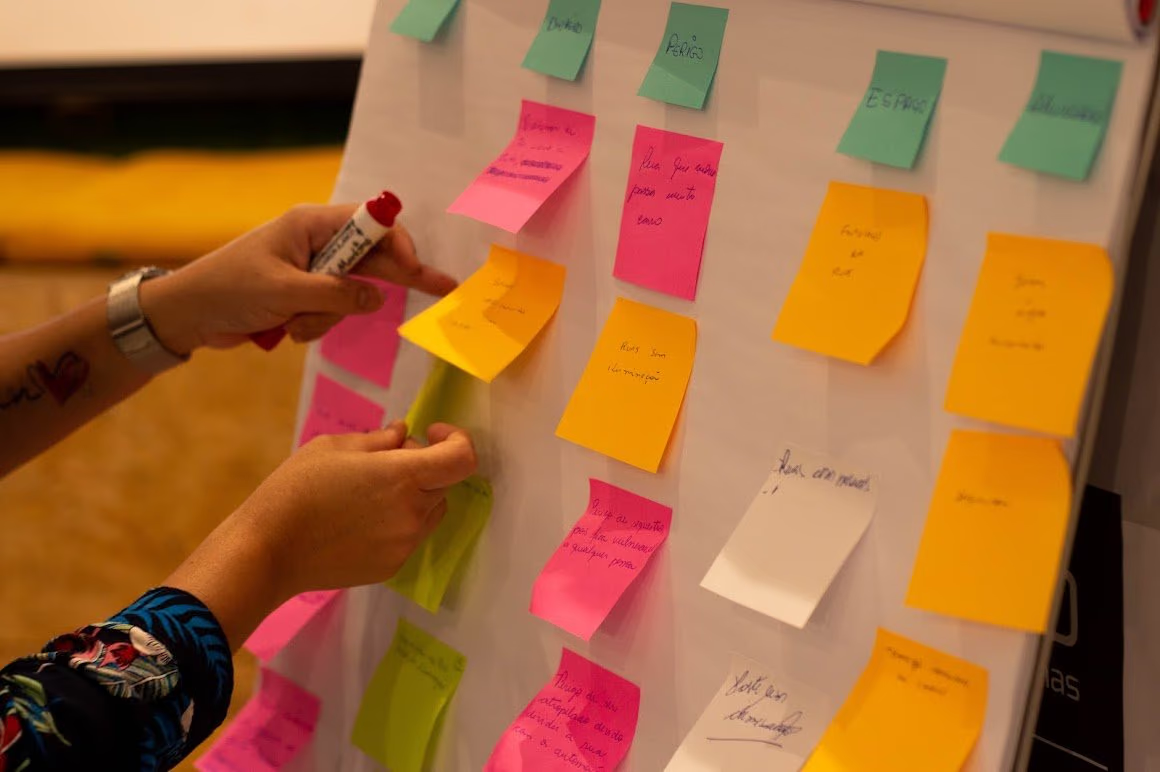
Hands of a participant organizing colorful sticky notes on a panel during a collaborative activity.
Casa Hacker’s Theory of Change starts from the understanding that collective action is essential to initiate transformation processes and that it is necessary to act upon power dynamics related to inequalities, exclusion, and barriers that prevent people from the outskirts from having access to opportunities and spaces for participation.
This vision helps us understand why the Active Citizenship Hubs cannot be analyzed solely by the number of activities carried out.
A training journey is important, but it is not the final goal. A call for proposals is important, but the financial resource alone is not the transformation we seek. Mentoring is important, but it also does not represent the destination point. These strategies are part of a broader set of actions aimed at strengthening leaders, initiatives, and communities.
In Casa Hacker’s own Theory of Change, community development appears associated with the capacity of communities themselves to propose solutions for their territories and the strengthening of local leaders to spearhead initiatives of social and economic impact.
It is from this perspective that I can look at the work carried out in the Hubs in a different way.
What we are doing now was designed to respond to a present need, but also to contribute to something that must continue afterwards. When we support a leader, we are not only interested in the outcome of that training cycle. When we support an initiative, we are not only thinking about the execution of that resource. When we bring organizations and territories closer together, we are also creating relationships that can continue producing effects in the future.
This requires a long-term vision.
And it also requires accepting that planning cannot be confused with an exact prediction of the future.
Good planning is not the one that manages to anticipate everything that will happen. It is the one that offers a direction clear enough so that decisions can be made when the unexpected happens.
It is precisely for this reason that I see the Theory of Change as both a methodology and a living instrument. It can be revisited by organizations, collectives, and leaders not only at the moment of drafting a project, but throughout its entire trajectory. It can serve to inspire a strategy, calibrate direction, review priorities, make decisions, adjust processes, or even recognize that a certain path no longer makes sense.
This possibility of revision is particularly important in initiatives that work with complex realities. If reality changes, our strategy may also need to change. If we learn something new, we may need to review a hypothesis. If a certain activity is not producing the expected result, we need to understand why and decide whether to adapt it or stop it.
This does not mean abandoning planning. It precisely means taking planning seriously enough to allow it to dialogue with reality.
Today, we are approximately halfway through the journey of the project we began designing in 2024. We can already look back and recognize an important part of the path traveled, but we still have a long way ahead. And perhaps this is precisely the most interesting moment to revisit the Theory of Change: when we already have enough experience to confront what we imagined with what is actually happening, but still have time to adjust the course.

A group of people gathered around a table during a work conversation, with cell phones, notebooks, and a laptop on the table.
At the same time that we execute what we planned, we are already starting to think about continuity. What do we want to remain after the project ends? Which methodologies need to be systematized? What capacities need to continue in the territories? Which relationships built during this process can turn into new partnerships? How can we ensure that investments made now can produce effects beyond the execution period?
Casa Hacker’s own Theory of Change points to results that go beyond specific initiatives, such as the development of community leaders, the strengthening of organizations, the creation and documentation of social technologies, the mobilization of resources, and the construction of an ecosystem capable of scaling these experiences.
It is a vision that naturally transcends the timeframe of a project.
Perhaps this is one of the main contributions of the Theory of Change for those who work with social impact: it helps us look at the project without confusing it with the transformation we wish to see.
The project has a schedule. Transformation has another pace.
The project has deliverables. Change is built by a combination of people, relationships, knowledge, resources, opportunities, and decisions.
The project may end. But what was developed by people and communities can continue.
When I think about the files I revisited from 2024, this is what stands out the most to me. It wasn’t simply the realization that we followed a plan. It was realizing that a vision built at that moment continues to guide decisions two years later.
Today we are living the process we designed back then. We are learning from it, adjusting what needs to be adjusted, and, at the same time, starting to think about what may come next.
Perhaps this is the most important part of a long-term strategy: not trying to control the entire path, but having enough clarity about the change we want to help build, in order to keep making coherent choices along the way.
And, in the case of the Active Citizenship Hubs, this journey is still happening.