This text sets out to discuss the importance of localising the way activities are developed and to consider how outreach sessions — the activities that invite young people to sign up for the Hackerclubes — are more than a way of promoting the project and end up offering young people a space for first contact with STEAM education, encouraging their development and showing that another kind of teaching is possible
The context of the activities
Casa Hacker has worked for many years developing initiatives aimed at peripheral communities, offering a space where social inequalities can be questioned and outmanoeuvred through innovation and agency. The Hackerclubes project is one of these initiatives: we go to schools in peripheral areas in the interior of São Paulo and offer young people hands-on experiences in technology. In this process we discuss mainly digital safety, 3D printing, programming, electronics and citizenship.
I have been one of the STEAM teachers on the Hackerclubes project since the middle of April this year, working in a pair at a state school in Sumaré. In this process, I found myself joining a class that was already under way, along with all the challenges that this change brought, both for me and for the adolescents. I had previous experience teaching art and technology in non-formal spaces, but none had given me the chance to enter a formal space such as a basic education school with a different proposal for teaching. Through this I understood that teaching technology and showing young people possibilities for their future also involves understanding the territory that surrounds them and what its dynamics are.
STEAM and its territorialisation
When we talk and read about the STEAM methodology, we frequently come across ideas and activities designed to work only in highly equipped environments, isolated from social reality. To territorialise STEAM means deconstructing that utopian view and understanding that innovation happens when we integrate technology, within its possibilities, with the real lives of young people. In a peripheral state school, teaching technology is not only teaching technical concepts, but translating knowledge and adapting to the reality of that community. This does not mean that we should settle or limit our activities, but that we need to understand the context we are in so as to show the many possibilities that technology offers us.
This process of territorialisation requires teaching to be built with the students, in a receptive way, recognising how technologies already run through the lives of these young people. Our role as educators is to listen and to understand how to build bridges between the knowledge they already have and the tools they need in order to be the protagonists of the STEAM learning process.
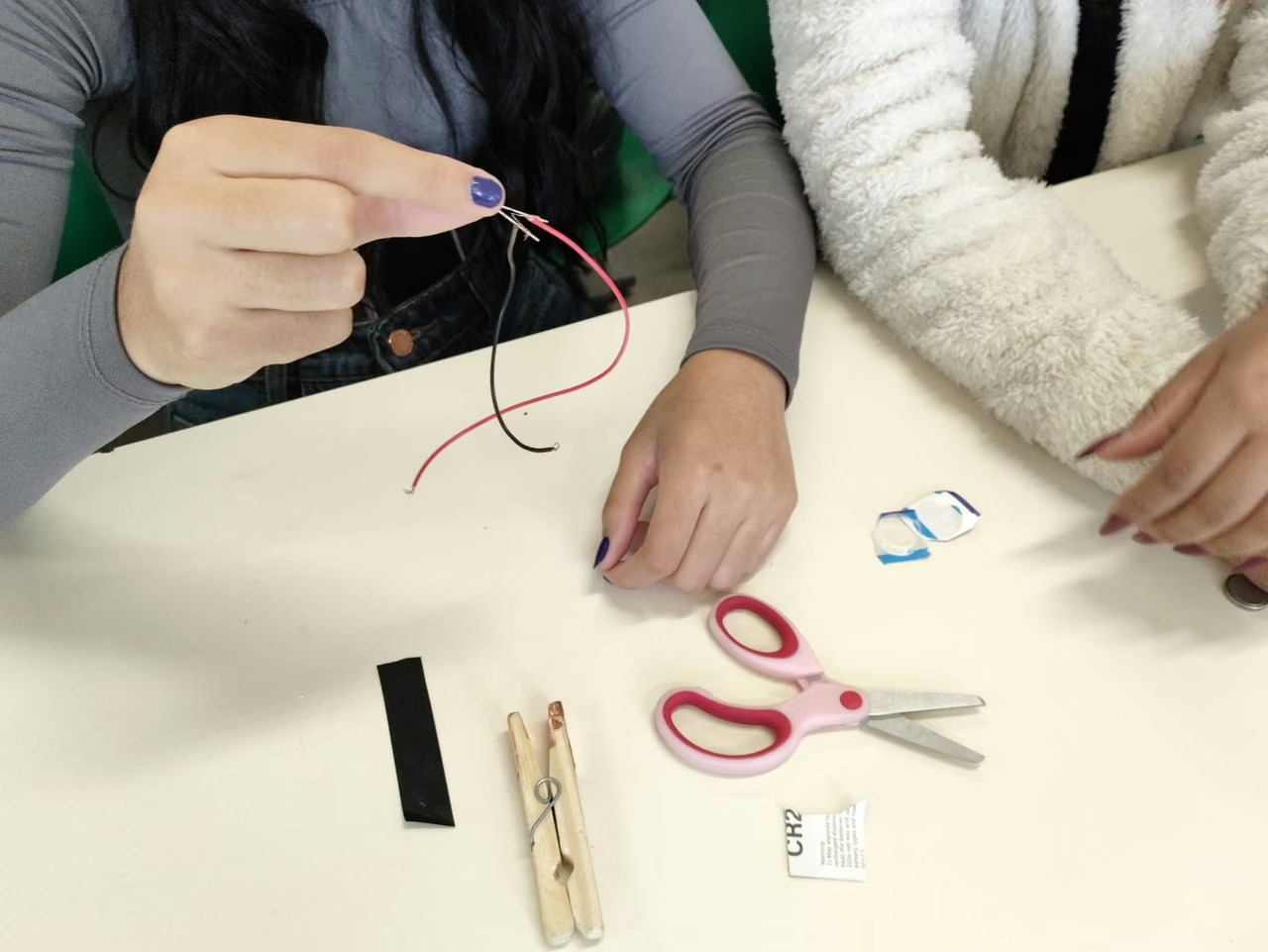
Outreach workshop in Sumaré
Outreach in practice
It is from this perspective that outreach becomes a pedagogical stage in itself, and not a mere act of publicity. This term I experienced my first outreach session: the moment when we go to the school and invite students to take part in a short workshop involving knowledge that will be deepened over the term in the Hackerclubes. During the activity we present the project, talk about the work of Casa Hacker, tell them what the classmates who took part before developed during their participation, and invite those present to sign up for the next group.
Thinking about the need for a playful activity that would catch their attention, be shorter in duration and could be run without the internet (bearing in mind the school’s infrastructure), we took an activity to the school using wooden clothes pegs, an LED and a battery, in which the students themselves assembled a circuit where squeezing the peg closed a circuit and lit the LED.
The process was challenging for the classes, but we were able to support the young people through it and every participating pair came away with a working circuit. The activity also ends up showing young people that the process of learning is often frustrating, but that we are together on that path, and that learning about technology is possible (and fun, too). To make the most of the excitement of the workshop, we made computers available so that the young people could sign up for the project, but we noticed something else: many of the adolescents, even at around 14 and 15 years old, already work outside school hours. In these situations, where the desire to learn runs up against the need to work, we offer to remain available on the days we are at the school and to encourage them to look for a future opportunity to become students on the project.
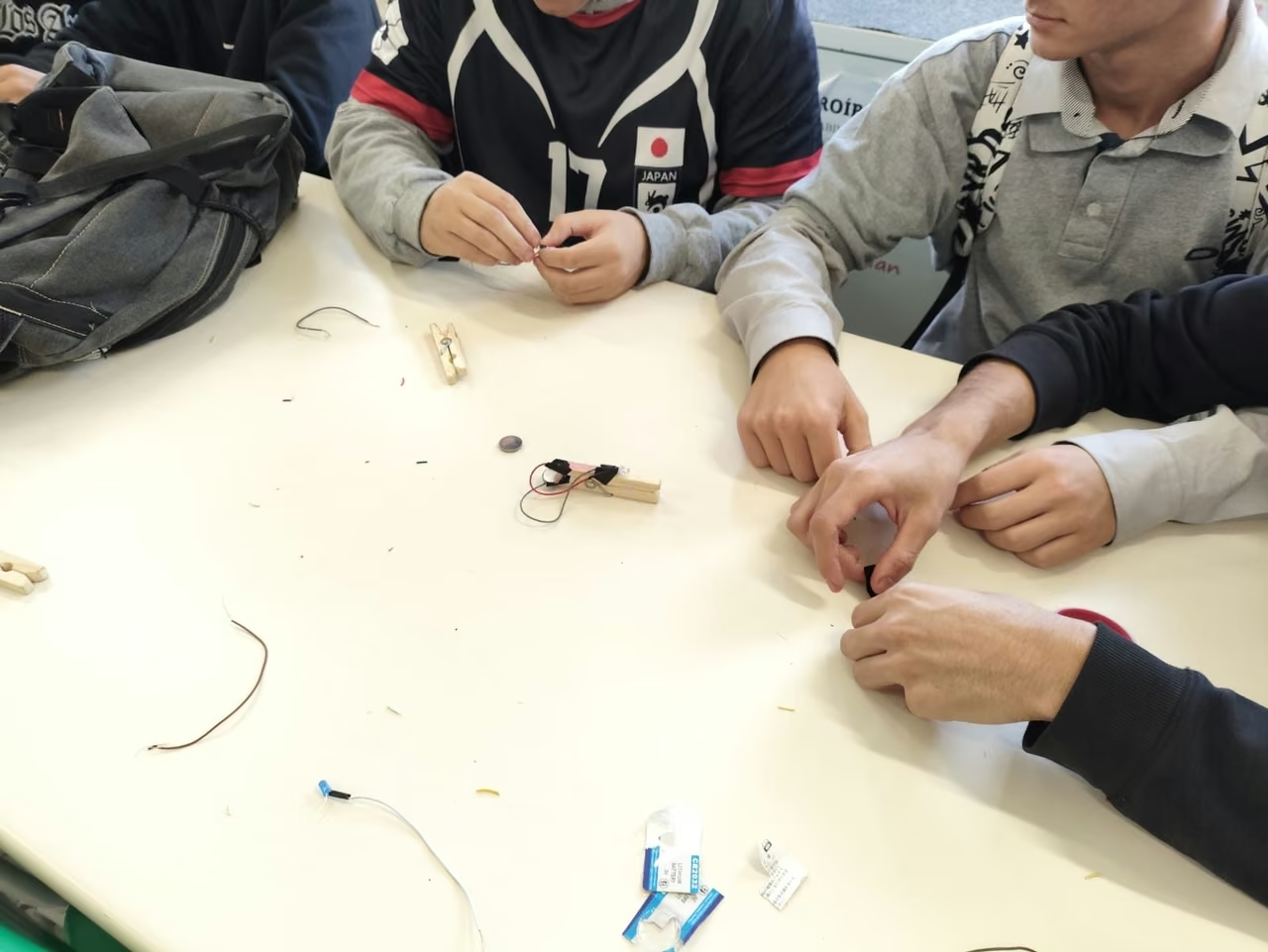
Outreach workshop in Sumaré
Possibilities and possible futures
Many of these adolescents already take on adult responsibilities, splitting their school routine with informal work, apprenticeship schemes and/or caring for the house and their siblings. It is deeply frustrating to see a young person want to join the project and be prevented by the immediate need to survive. This situation shows that inequality runs very deep and still needs a great deal of collective work to be overcome.
Bringing the Hackerclubes into the public school system turns out to be a constant exercise in balance between discovery and awareness of the limits imposed by the territory. Even for those who could not enrol because of the constraints of their routine, this outreach experience was not lost: it may have become the understanding that they are capable of creating with technology. STEAM teaching in localised contexts fulfils its role when it shows young people from the periphery that the technological future should not be the privilege of a few, but a right that belongs to them too.